Interest rates surged higher this week. Big Cap tech stocks rose; other sectors fell
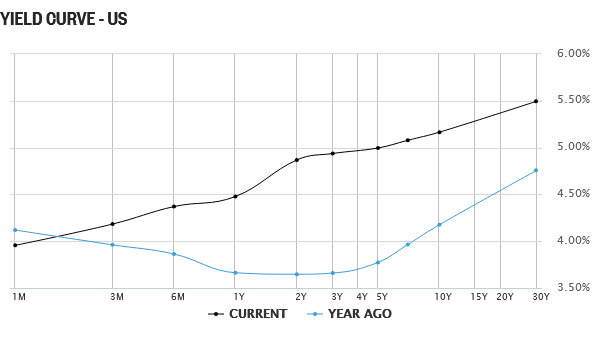
US long-bond prices have tumbled since the start of the war in Iran (blue ellipse). Yields on the 30-year have risen from ~4.62% to a 22-year high of ~5.52% on Friday (pink ellipse).


Bond market VOL is measured with the MOVE Index (Merril Lynch Option Volatility Index), and it surged higher as bonds tumbled this week.


This chart shows the MOVE Index (blue line) and the 10-year yield (gold line) spiking together this week.

This chart shows the MOVE Index (gold line) spiking this week while the VIX (blue line) remains near the lows of the last two years. Bond market VOL surged higher, while stock index VOL remained quiet.

The VIX is quiet even as bond market volatility surges higher.

This chart from rateprobility.com shows the market is now pricing in ~21 bps (85%) of another hike from the FOMC at the October 28 meeting, just days before the midterm elections. The chart also shows the market expects the effective funds rate to be ~90 bps higher than the current 3.88 level by September 2027.

Upward pressure on interest rates is coming from 1) rising inflation expectations (especially related to the knock-on effects of higher energy prices), 2) rising supply as governments and corporates issue more bonds, 3) rising economic growth; the S&P global PMIs on Wednesday were much stronger than expected, causing bond yields to spike higher, and 4) investors becoming less “price agnostic,” demanding higher yields, especially due to debasement fears from ever-rising government fiscal deficits.
I understand the classic argument that breakevens do not show “inflation” as a significant factor in rising bond yields. Still, I can’t imagine 10-year real yields surging from ~1.8% at the start of the war with Iran to current multi-year highs of ~2.85% while ignoring the impact of rising energy prices on inflation and inflation expectations.

US bond yields fell to record lows during 2020, and prices rose to record highs. Since that historic peak in 2020, the price of the US long bond has fallen by more than 50%.

Interest rates surged higher this week, but so did the S&P index
The S&P slipped ~4% from mid-August record highs to last week’s lows, rallied sharply on Monday, and held most of those gains through Friday’s close despite choppy mid-week price action tied to developments in the energy and interest rate markets.

The Nasdaq index outperformed the S&P this week, reaching new record highs and was the strongest of the major indices.

Gains in Big Cap Tech shares drove the gains in the S&P and the Nasdaq. The MAGS ETF rallied to record highs this week. (META surged to record highs on MUSE). The top 10 market cap stocks in the S&P account for ~40% of total S&P market cap, a historically extreme market concentration.

The equal-weight S&P continued its decline and is now down ~6% from mid-August record highs.

The A/D line also fell from mid-August record highs.

Bank shares continued their decline from mid-August record highs. The SPDR ETF of bank shares was down ~11% at this week’s lows.

The DJIA is down ~6.5% from its record high in early August.

The DJT is down ~14% from its July highs (rising fuel costs are a factor).

The Russell 2000 small-cap index is down ~8% from its mid-August record highs.

Currencies
The USDX broke out higher after the September 16 hawkish FOMC meeting.

The Canadian Dollar has dropped from around 73 cents to 71 cents over the last three weeks as the USD has gained against nearly every other currency. The interest rate differential between Canada and the USA at the 2-year tenor is historically very wide, at ~152 bps.

The Japanese Yen also weakened against the USD after the early September “unofficial intervention rally” but bounced back a bit on Friday, likely on intervention fears.

Energy
Front-month Brent reached a high of $110 in early September, fell back to ~$97 early this week, but ended the week about where it started, ~$ 104.

Front-month ULSD NYMEX futures reached record highs last week as markets buzzed about diesel shortages and possible export restrictions. (Doomberg reported that roadside diesel in France was over $10 a gallon). NYMEX futures slumped nearly 15% to this week’s lows on high volume and a very sharp drop in open interest (long speculators turned sellers?), even as Ukraine continued to hit Russian refineries. Mogas season is ending, and heating season is coming.


What’s Trump going to do?
The polls are forecasting a Blue Wave.

On my radar
PCE on Wednesday and NFP on Friday could rock the market. A diplomatic off-ramp between the US and Iran looks unlikely.
My short-term trading
I started this week with long OTM calls on the 10-year bonds. I covered early Wednesday morning for a modest loss, and was glad I did when the market tanked on the S&P Global PMI report.
I shorted the S&P on Wednesday, Thursday, and Friday, expecting a broad-market break from rising interest rates. My P&L showed a tiny net loss on the trades because of poor entry points, even though the S&P fell ~150 points from Wednesday’s high to Thursday’s low.
The Barney report
Summer is over and the rainy season is here. I’ve been putting a raincoat on Barney. This photo shows where Barney’s name came from. Mordecai Richler was one of my favourite writers, and I thought Barney’s Version (1997) was his best book. They made a movie in 2010, with Paul Giamatti as Barney, which I thought was pretty good.

Listen to Mike Campbell and me discuss markets
On this week’s Moneytalks show, Mike and I discussed how sharply higher interest rates affect markets. You can listen to the entire show here. My spot with Mike starts around the 1-hour and 37-minute mark. The show is longer than normal, with two great interviews with Pipa Malmgren and Rick Rule.

The Archive
Readers can access any of the weekly Trading Desk Notes from the past six years by clicking here.
Subscribe: You have free access to everything on this site. Subscribers receive an email alert when I post new content, typically four to six times a month.
Victor Adair retired from the Canadian brokerage business in 2020 after 44 years and is no longer licensed to provide investment advice. Nothing on this website is investment advice for anyone about anything.