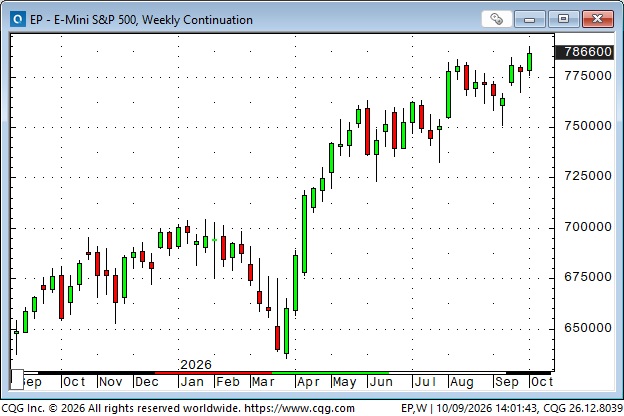
The S&P closed at a new record weekly high
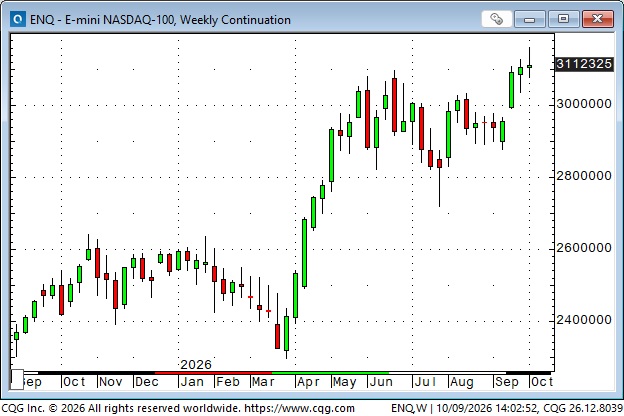
The S&P last posted a record-high weekly close on August 14. It trailed off about 3.5% over the next five weeks (as did the Nasdaq), but a renewed surge in big-cap tech over the last three weeks has lifted both indices to record highs.
Today’s note will be brief. My website is moving to a new server this weekend, so I’m writing a brief note on Friday – front-running the move!
While the S&P index is at a new record high, ~425 (85%) of the 500 stocks are down more than 10% from their highs, and ~300 (60%) are down more than 20% from their highs.

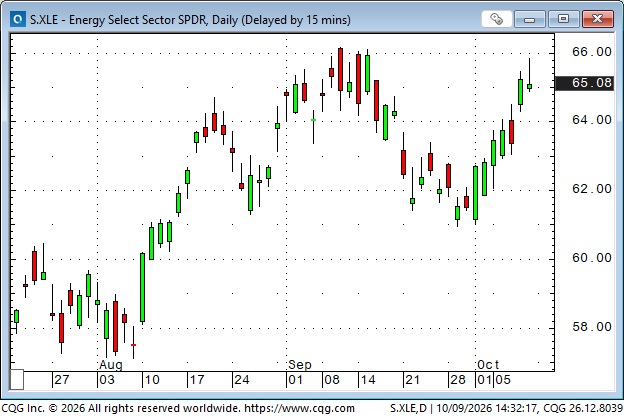
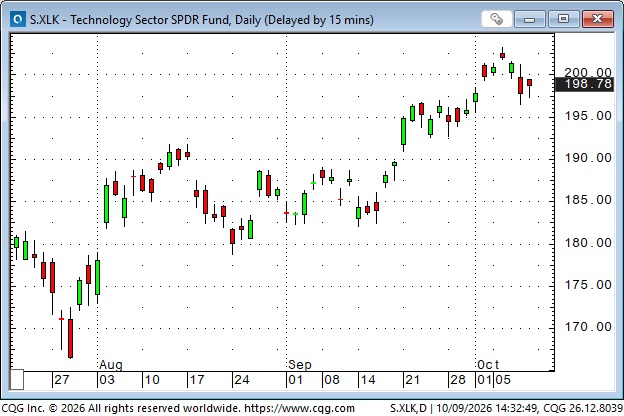
Energy and Technology are the only sectors trading above the mid-August highs.
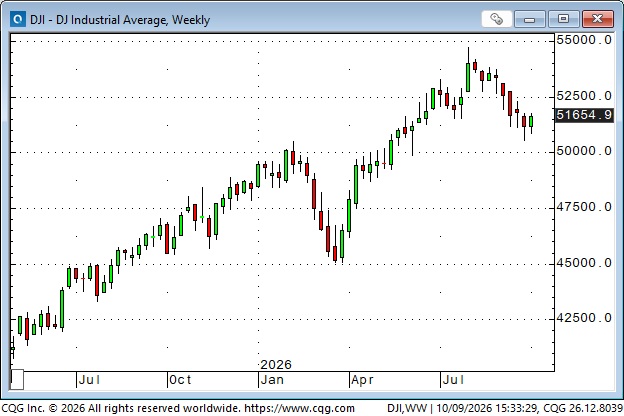
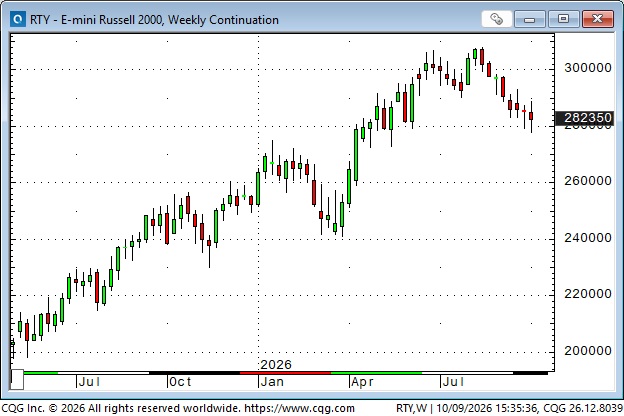
The DJIA closed this week down ~3,000 points (~6%) from its early-August record highs, and the Russell 2000 small-caps index is down ~10% from its mid-August record highs.
We’re entering the heart of earnings season over the next couple of weeks, and the market expects more robust earnings growth. However, the top ten stocks are expected to account for ~2/3 of that growth.

The S&P index seems impervious to higher interest rates; or at least the top 10–20 stocks are (so far), but higher rates may be partially to blame for the declines (since mid-August) in the majority of stocks.
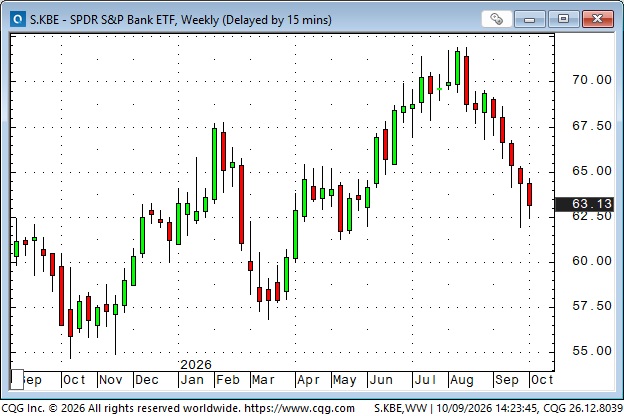
The banking sector ETF (KBE) is down ~12% from its mid-August highs.
The S&P index (and the Nasdaq) doesn’t seem to be “worried” about the Russia/Ukraine war, the war in Iran, the sharp rise in interest rates, the sharp rise in fuel prices, or the prospect of the Democrats taking control of the House and the Senate. (The Midterms are 16 trading days away). The S&P is so “dominated” by big-cap tech that it no longer works for me as a cross-asset “risk barometer.”
Much depends on continued strength from big-cap tech and AI. This week’s strong close suggests the market’s verdict is “onwards and upwards.” Still, questions remain about the massive borrowing, Chinese competition, NIMBY issues, and, most importantly, whether the payback will be worth it.

One reason prices are higher is the tidal wave of capital flowing into the market via ETFs. The flow is estimated at ~$1.5 trillion YTD, or about $8 billion a day, with ~90% passively allocated, meaning Big Cap tech gets the lion’s share of the capital inflow.
Interest rates
Global bond yields continued to surge higher early this week (US Treasury long bond yields were at their highest in 24 to 26 years); but yields turned sharply lower on Thursday (prices higher), triggered by solid auction results and a brief drop in oil prices following Trump’s tweet about no attack on Iran before the midterms. Bonds were also heavily “oversold,” with doomscrolling rampant, so at least a “bounce,” if not more, was warranted.

Canadian bond yields rose to 3-year highs, German yields to 17-year highs, French yields to 24-year highs, and UK yields to 34-year highs.
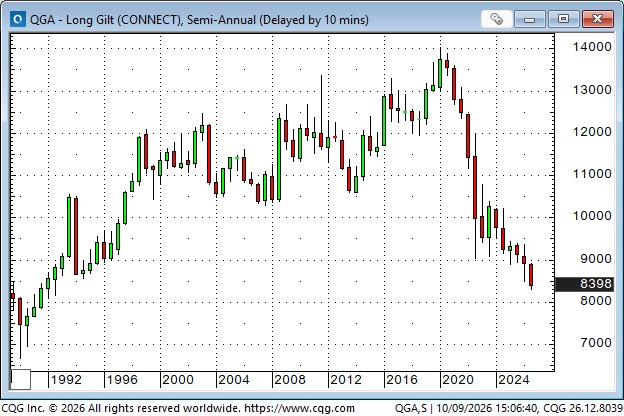
The UK gilt peaked in 2020, when global bond yields hit historic lows (the US 10-year Treasury yield was 0.50%). In December 2020, total sovereign and corporate debt with negative yields was ~$18.5 trillion (~25% of total debt). Debt issued in the 2020–2022 period that is being refinanced now must pay a substantially higher yield.
Currencies
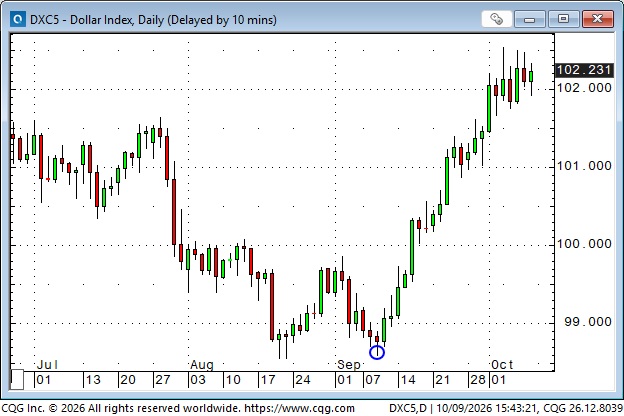
The DXY US Dollar Index closed this week at an 18-month high, up ~4% from its early September lows (blue ellipse).
The Japanese Yen reached a 7-month high in early September (blue ellipse), up ~7% from 35-year lows reached in late July, following official (and maybe some unofficial) intervention by Japanese authorities (with a little help from Scott Bessent). It has fallen away from those early September highs as the USD has rallied against virtually all other currencies.

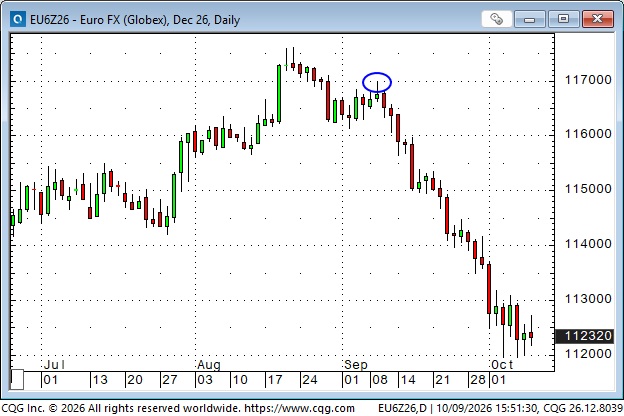
The Euro had a “lower high” (blue ellipse) in early September before beginning a relentless month-long decline to this week’s lows.
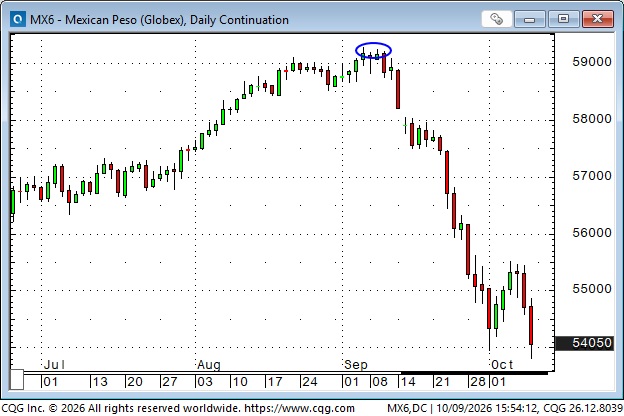
The Mexican Peso began a steep month-long 8% decline in early September (blue ellipse).
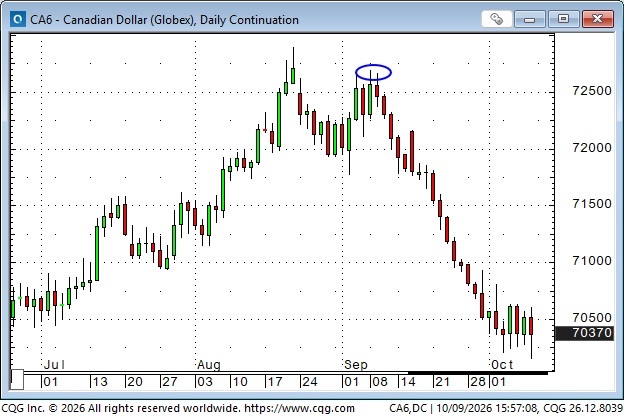
The Canadian Dollar also began a steep 3.5% decline in early September (blue ellipse).
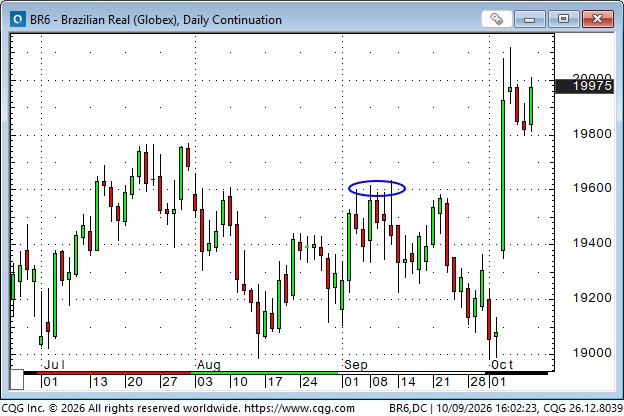
The Brazilian Real began weakening against the USD in early September (blue ellipse). Still, that decline was sharply interrupted on Monday when Bolsonaro took a strong lead over Lula in the preliminary round of the national elections. The Real jumped ~5%, and the stock index rose ~15% on the election results. The election run-off round is scheduled for October 25.
Part of the strength of the US Dollar is actually a reflection of the weakness of the Euro due to “stress” in the European bond markets, particularly in France.
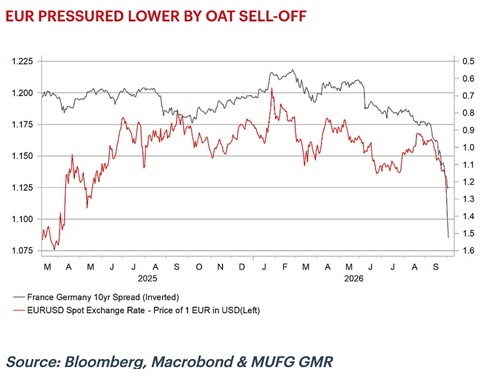
Interest rate differentials between different currencies
If French interest rates are rising from fiscal “distress” rather than from stronger economic growth/tighter monetary policy, then higher rates depress the Euro rather than supporting it.
Energy
Front-month Brent crude has traded mostly between $100 and $110 over the past five weeks, as markets believe Middle East crude exports are nearly back to prewar volumes despite sporadic attacks on shipping. Product exports (diesel, gasoline and jet fuel) are thought to be running at less than 50% of prewar levels, with LNG exports at ~20% of prewar levels.
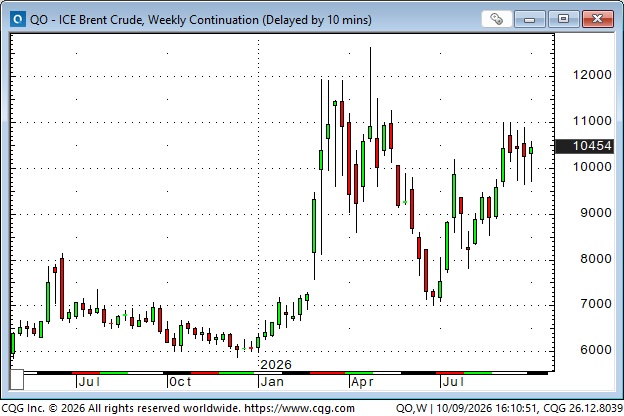
Front-month WTI has mostly traded between $90 and $100 over the past 5 weeks.
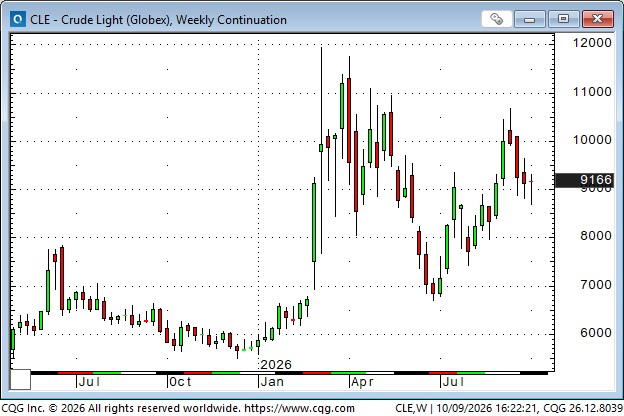
December Brent has rallied to a substantial premium over December WTI during the past 6 weeks. Both markets are in steep backwardation, and the WTI front-month is now November (though December has more open interest), while the Brent front-month is December, which may explain part of the premium. But I think another part of the premium is that WTI is American oil, while Brent is a global benchmark and is more closely aligned with ME prices than WTI.

Last week I noted that “the $25-30 premium of Brent above prewar price levels may represent a “risk premium.” But I now think that part of the premium represents the “substantial” increase in shipping/insurance/etc. costs incurred in transporting crude from the Middle East to buyers. Those higher costs may also be widening the Brent/WTI spread.
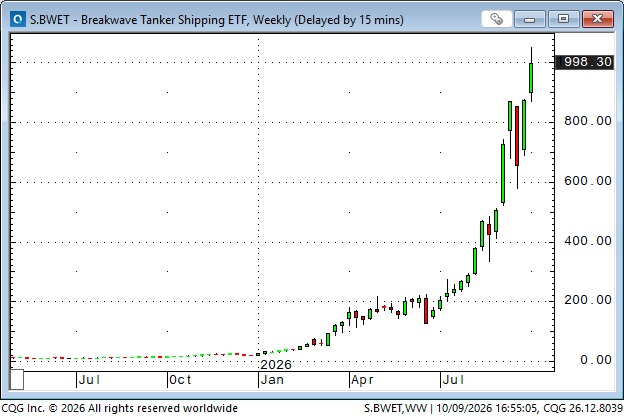
Hurricane Isaias has caused production cutbacks in the Gulf of Mexico and may also lead to production cutbacks at US Gulf Coast refineries. NYMEX ULSD and gasoline futures remain near recent highs.
Thoughts on trading
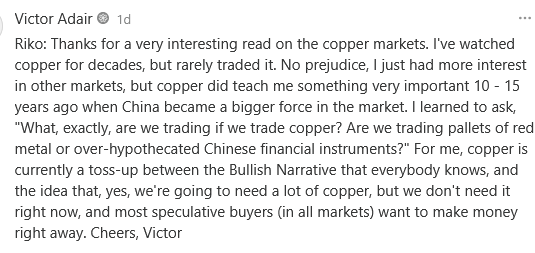
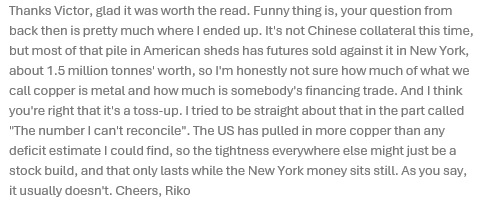
I’m a subscriber to Riko Kardamow on Substack, and I’ve recommended him to readers. He recently wrote a very detailed piece on the copper market. I commented on it, and he replied. Here’s our exchange:
Trading quote of the week

My short-term trading
I started this week short the S&P, a position I put on just below last Friday’s highs. The trade was modestly profitable going into Friday’s close, so I stayed with it. I covered it for a slight loss when the floor session opened higher on Monday, and was glad I did, as the S&P rallied over 100 points into Tuesday’s all-time highs.
I wrote OTM puts (30 delta) on the 30-year bond futures on Monday. The options had about 3 weeks to expiry. VOL was ~15%, which was very high. The market went against me a bit on Tuesday and Wednesday, but bonds rallied hard on Thursday, and the option premiums evaporated. The puts lost over 50% of their premium by Friday’s close, and I kept the trade into the weekend.
I bought CAD on Tuesday but got stopped out for a slight loss on Wednesday. I bought it again and was stopped out following the much-weaker-than-expected employment report this morning. I rebought it when it began to recover from the lows and kept the trade into the weekend.
The BC election
The NDP party called a snap election for October 24 a couple of weeks ago when the opposition parties were in disarray.
I dread the possibility of another 4 years of a Provincial NDP government because they fundamentally oppose competition and believe it is right to punish success with higher income taxes.
Both Left and Right parties have good and bad ideas/policies, but I’m disappointed that the global trend seems to be moving toward the extremes on both sides. I think/hope the Silent Majority prefers the Center.
Here’s a link to a 2-minute ad in support of the BC Conservative Party: M2621302 26 TRS BRN TIMSPARTNERSHIP YT AWAR CXQ EN 0 6sec YOUTUBE6SEN
The Barney Report
Barney loves to jump up on rocks, logs, and sometimes our living room furniture to get a better look around. Here he is on a Bluebird day up on a four-foot rock under the power lines. He is a happy Boy!

Listen to Mike Campbell and me discuss markets
On this week’s Moneytalks Show, Mike and I discussed the bifurcated stock market, interest rates and my idea that the S&P Index is no longer a valuable risk barometer. You can listen to the entire show here. My spot with Mike starts around the 1-hour 10-minute mark. I also recommend readers listen to my good friends Paul Beattie and Andrew Rhuland, who are interviewed on the show.
The Archive
Readers can access any of the weekly Trading Desk Notes from the past six years by clicking here.
Subscribe: You have free access to everything on this site. Subscribers receive an email alert when I post new content, typically four to six times a month.
Victor Adair retired from the Canadian brokerage business in 2020 after 44 years and is no longer licensed to provide investment advice. Nothing on this website is investment advice for anyone about anything.