
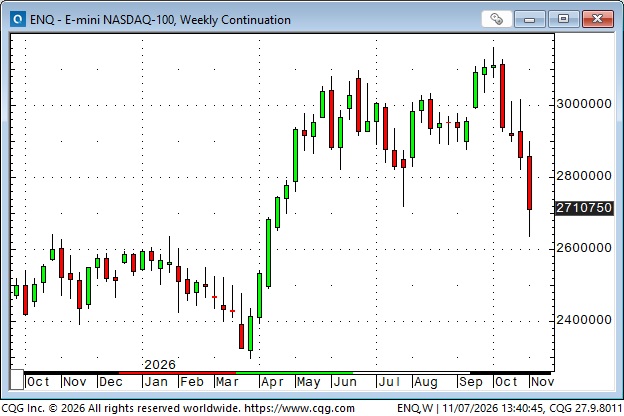
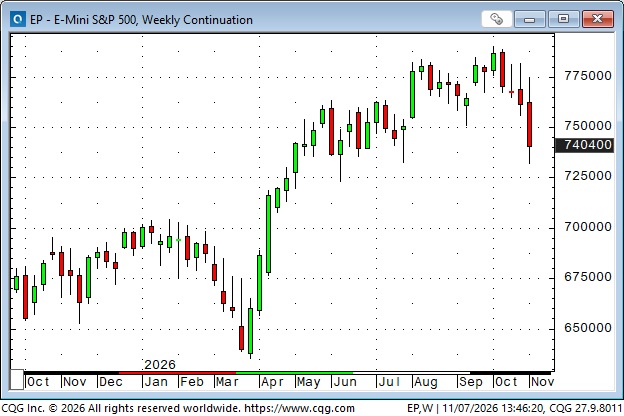
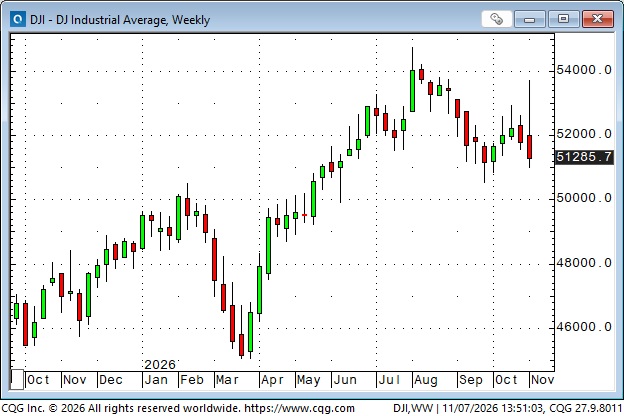
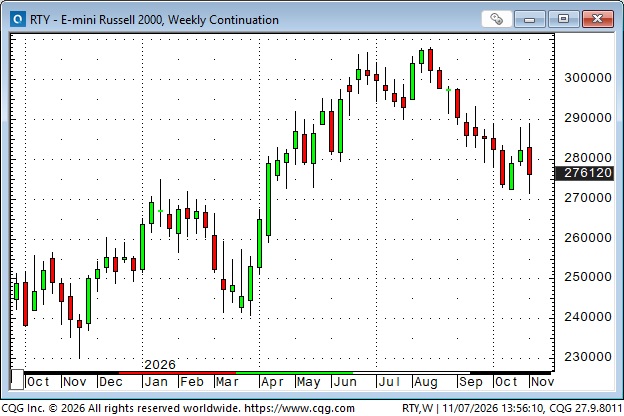
The leading US equity indices fell again this week
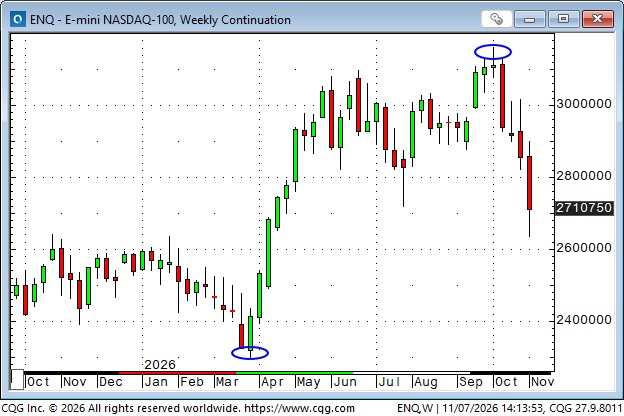
Nasdaq futures fell to a 7-month low, down ~17% from the all-time high made five weeks ago.
S&P futures fell to a 6-month low, down ~7% from the all-time high made five weeks ago.
The venerable DJIA traversed a 2,700-point range this week and closed ~6% below the all-time high made in early August.
The Russell 2000 (small cap) futures index closed ~12% below the all-time high made in August.
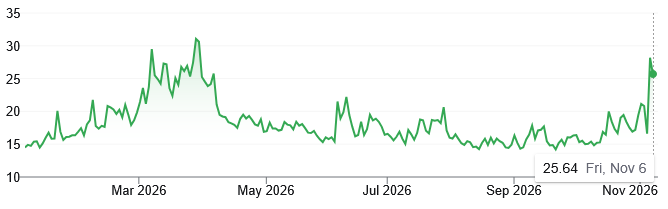
S&P Index VOL, which has been significantly subdued relative to individual-stock VOL, jumped to 7-month highs this week.
From the YTD lows reached in late March to the all-time highs made in early October, the S&P rallied ~24% while the tech-heavy Nasdaq rallied ~37%.
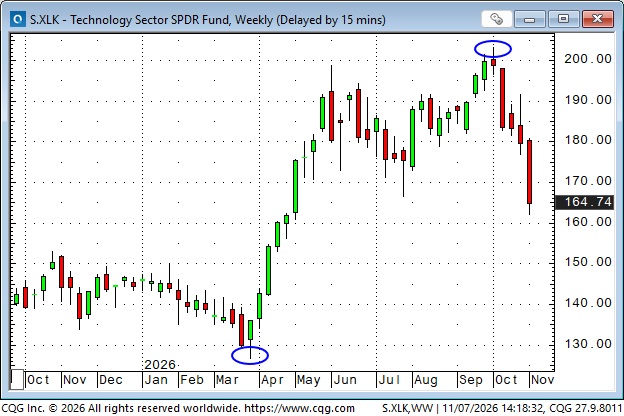
The XLK technology ETF rallied ~44% from the March low to the October high, and fell ~20% from that all-time high to this week’s low.
The rally from the 2022 lows to the October 2026 highs in the S&P (up ~125%) and the Nasdaq (up ~210%) was driven by rising earnings and the expectation of even higher future earnings. The tech sector provided the lion’s share of that earnings growth, and, over the past 5 weeks, there have been “second thoughts” about the trajectory of future tech earnings, especially following this week’s US elections.
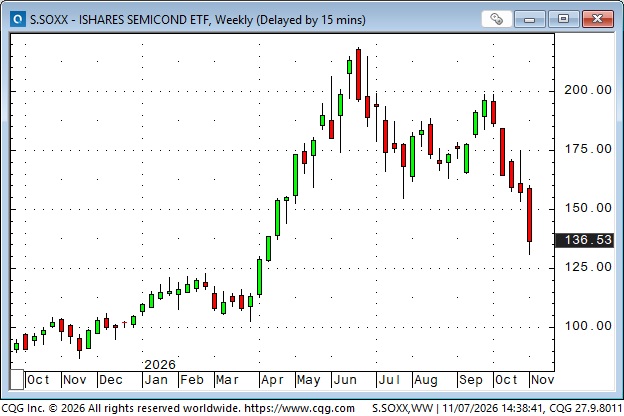
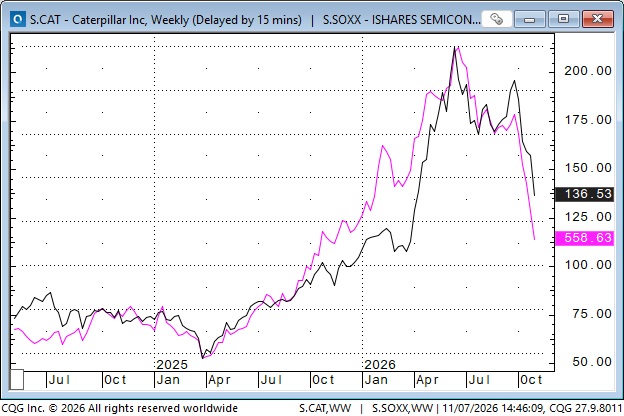
The SOXX index soared > 4X from Liberation Day lows in April 2025 to record highs in June 2026 as leveraged capital flowed into anything and everything associated with memory, compute, and data centers. At this week’s low, the SOXX was down ~40% from the June high.
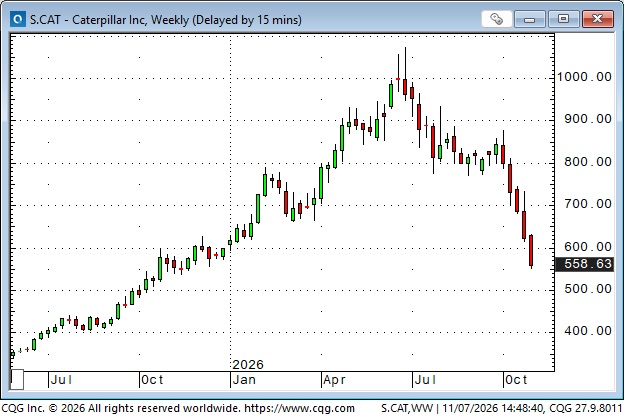
I have previously posted charts of CAT, pointing out how I saw it as a “picks and shovels” play on the data center gold rush. (CAT has a subsidiary that makes gas turbines, which could generate electricity for data centers.) CAT is down ~48% from the June 2026 all-time highs.
Here’s a chart of the CAT/SOXX correlation. CAT is the pink line. (I had an idea to create this chart, and I thought the correlation would be close, but this is amazing!)
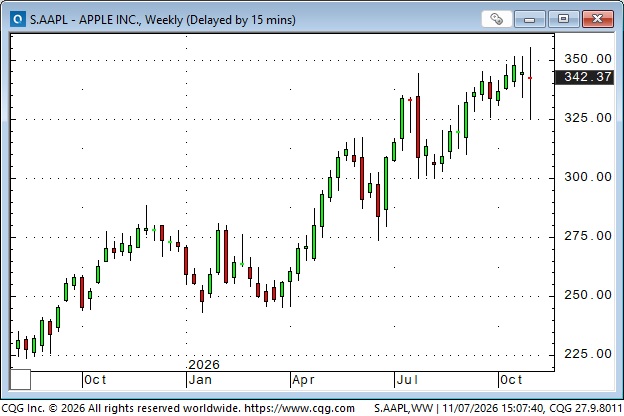
I have also previously posted charts of AAPL, referring to it as a “refuge” within the tech sector, since it isn’t a play on the “AI/data center” story. Despite a $20 dip from last week’s close following Monday’s quarterly report, AAPL bounced back and remains a “refuge” within the tech sector.
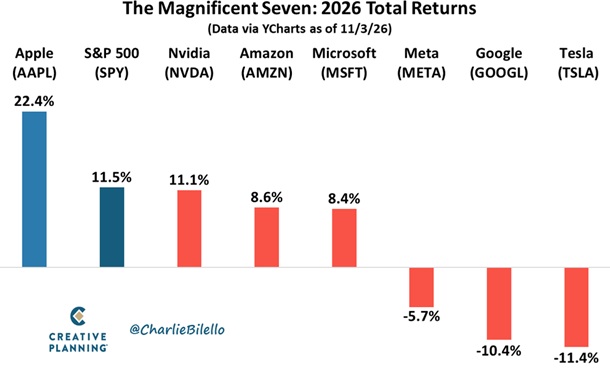
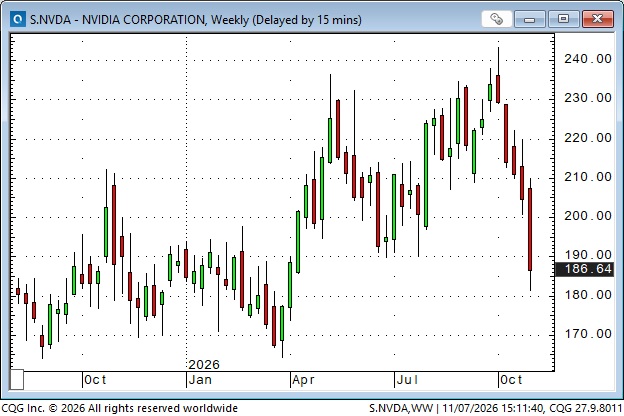
NVDA has closed lower for 5 consecutive weeks, down ~26% from the early October all-time high. NVDA reports on November 17.
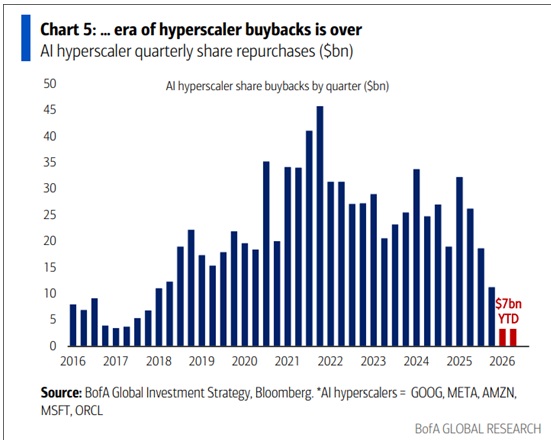
Bye-bye buybacks.
Energy
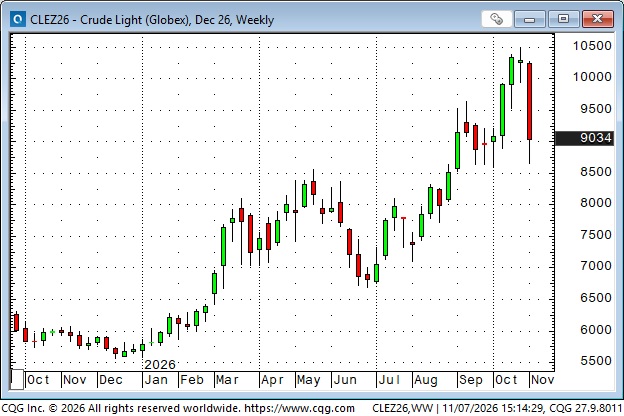
Crude oil: front-month futures closed at life-of-contract highs last week (Brent ~$114, WTI ~$105), with a $20-$30 risk premium as the market worried about escalation in the war with Iran.
Prices fell $15 to $20 this week as the market priced in an increased chance of a diplomatic end to the war. (The risk premium collapsed). Vice President Vance said, “The reason we lost the election: the war with Iran.”
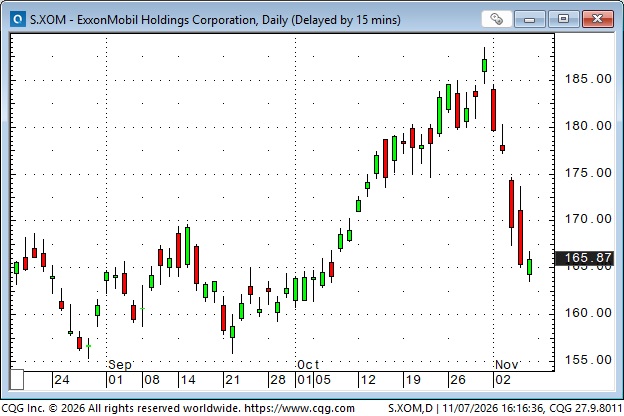
XOM closed at a record high last week, but slumped ~13% to this week’s lows.
Gasoline and diesel prices were also lower this week but are still close to record highs.
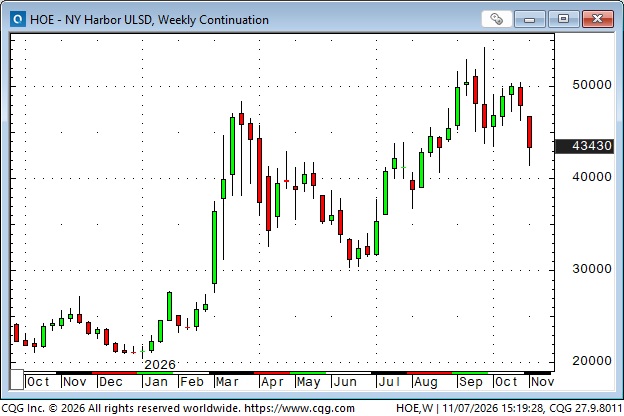
The world has plenty of crude oil (US crude oil production reached a record high of 14 mbd), but it’s much more expensive to ship than before the war with Iran. The world remains short on refining capacity because of damage to refineries in the Middle East and Russia (and after years of “environmental” refinery shutdowns). My best guess is that ~12% of nameplate global refinery capacity is offline, and many refineries have been running at max capacity while postponing necessary maintenance shutdowns to capture rich profit margins.
Riko Kardamow posted an interesting Substack piece this week detailing how China reduced its crude imports by ~3mbd in April 2026 and has maintained imports at that reduced level.
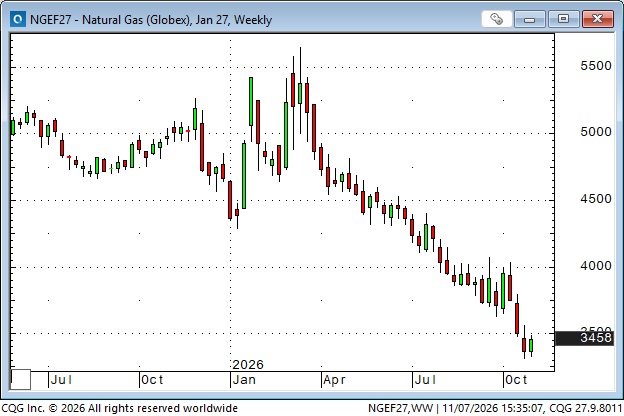
NYMEX natural gas for 2027 winter delivery has been in steady decline since the early days of the war with Iran, as more and more gas is produced as a byproduct of oil drilling. Prices perked up a little this week. Doomberg tells us that US (and Canadian) natural gas is so cheap that its “energy equivalence” with crude oil is ~$6 to $ 12 per barrel.
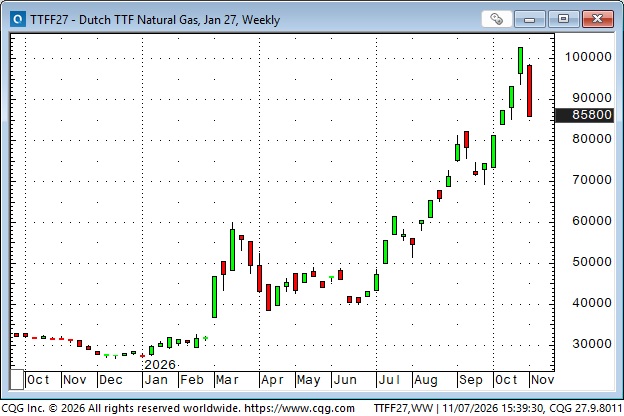
Dutch TTF LNG prices for 2027 winter delivery more than doubled from this past summer to last week’s close, but fell back this week (perhaps in “harmony” with the ~$20 decline in crude prices).
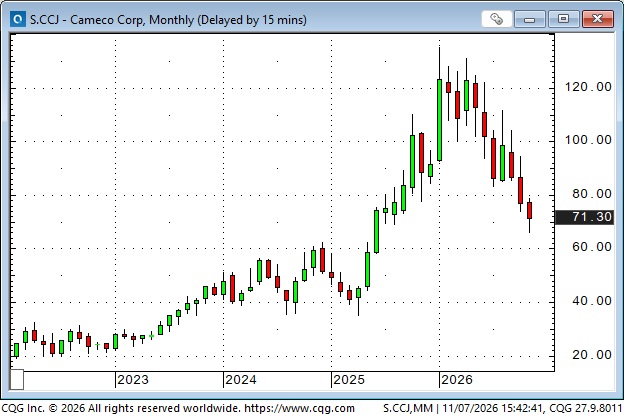
The uranium sector had a great run in 2025 and into early 2026, but Cameco shares (my barometer for the uranium sector) have fallen ~50% from the highs.
Metals
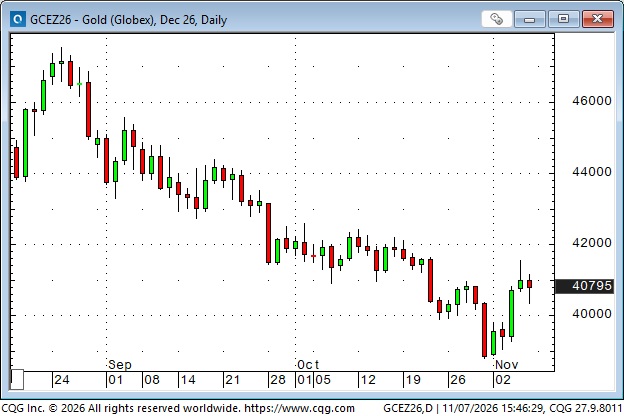
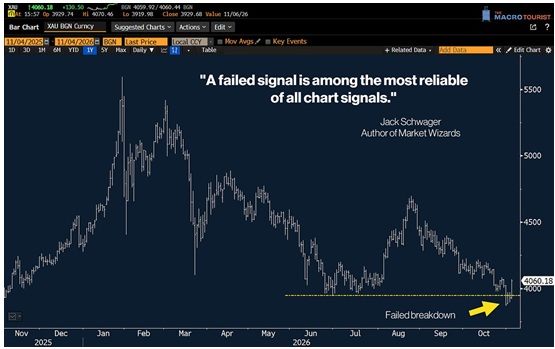
Gold fell to a 12-month low last week, down ~30% from January’s record highs, but bounced back ~$275 at Thursday’s highs.
Jack Schwager (author of the Market Wizards series) says this week’s “bounce back” in gold sets up a “failed breakdown.”
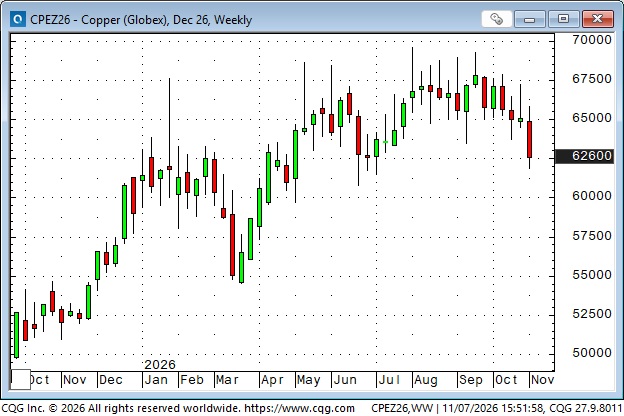
COMEX copper prices reached record highs this summer on the “electrification of everything” story, but slipped to 4-month lows this week as prospects for data center demand dimmed.
Interest rates
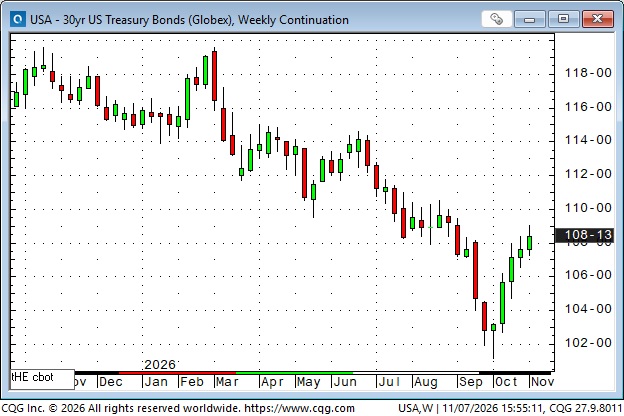
The CBOT 30-year bond futures have closed green for 5 consecutive weeks (tell me there’s no correlation with Nasdaq futures closing lower for five consecutive weeks). The ~$20 drop in crude prices this week may have also given bonds a boost.
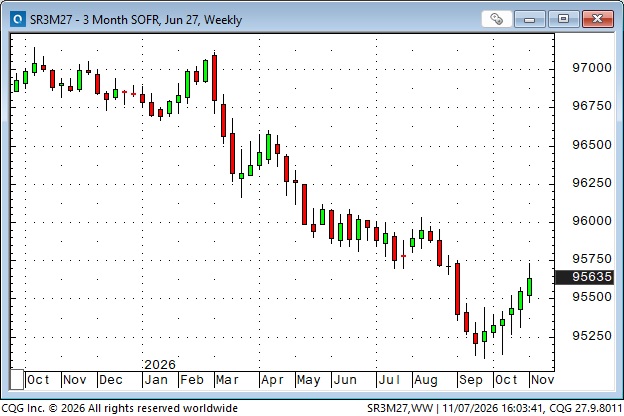
CME SOFR futures for June 2027 have closed higher for 6 consecutive weeks, pricing out about 50bps of Fed tightening from what was expected 7 weeks ago.
The Fed
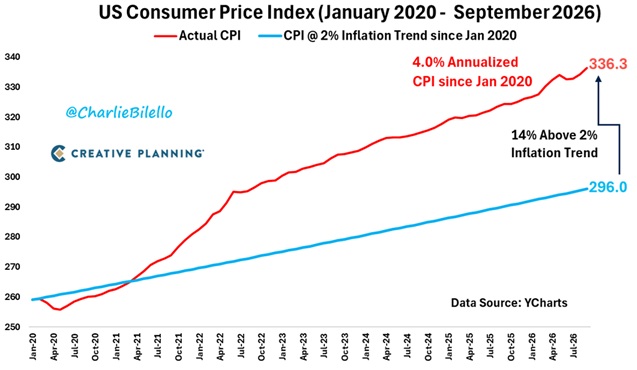
This week’s employment and economic data, including upward revisions to prior reports (not to mention that voters declared high and rising inflation to be their #1 concern), have the market pricing in a 76% chance of the Fed raising rates at the December 9 FOMC meeting. (Unless, of course, there is a “diplomatic resolution” to the war with Iran, and crude prices tumble, along with future inflation expectations).
For more on a “diplomatic resolution,” see a post by Tracy Shuchart on Substack. It is way more complicated than Trump simply signing something with a Sharpie. After reading Tracy’s post, I thought that the market is probably overpricing the odds of a peace agreement.
Currencies
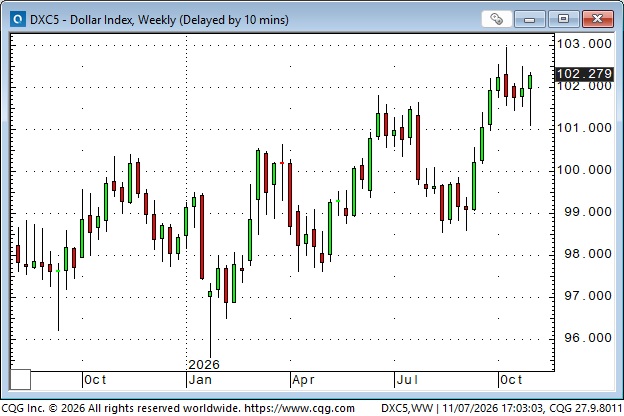
The DXY US Dollar Index dropped to a 5-week low on Wednesday after the US election results, but bounced back smartly after Friday’s strong employment report. While the huge US trade deficit and the huge US fiscal deficit may be negatives for the USD, capital flowing to the US for investment opportunities has supported the USD. If American equities weaken, will some of that capital inflow be repatriated? (especially to Japan).
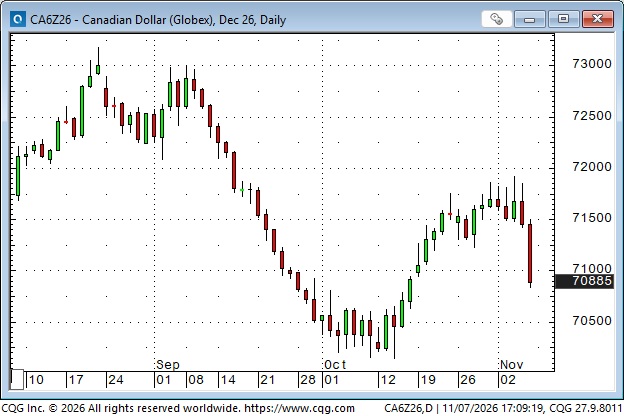
The Canadian Dollar made a 6-week high on Wednesday as the USD was generally weaker against all currencies following the election. However, that sentiment was short-lived, and the CAD turned lower on Thursday before tumbling on Friday as strong US employment data drove the USD higher against all other currencies. The weak Canadian employment data exacerbated the CAD decline.
My short-term trading
I started the week short copper. I’ve been trading copper from the short side for the past few weeks on the idea that the market may have been “over-pricing” the AI/data center demand for copper. I’ve made money on that idea, but I covered my short on Tuesday (Ididn’t like the election risk) and missed the Thursday break to new 4-month lows.
I watched the S&P rally over 200 points from overnight lows on Wednesday, following the Tuesday election. When the rally “ran out of gas” late Wednesday, I got short. The market weakened overnight and “absolutely collapsed” Thursday morning. I couldn’t stand the prosperity and took profits! The market fell further without me, but bounced back a bit on Friday.
I bought the Yen on Thursday as the US equity market plunged, thinking “possible Japanese repatriation .” I was ahead on the trade overnight, but the Yen (and most other currencies) tumbled on the US employment data Friday morning, and I was stopped out.
My net P&L was up nicely for the week, and I was flat going into the weekend.
The Barney report
It was “take the puppy for a walk in a windstorm” day today, with winds gusting near 8o kph and leaves blowing everywhere. Barney loved it! Here he is catching his breath on the 18th tee box.

Listen to Mike Campbell and me discuss markets
On this week’s Moneytalks Show, Mike and I discussed the wild volatility in the equity markets following this week’s elections. We also talked about the tumble in crude oil prices as the market swung from pricing in a possible escalation in the Iran war to a possible diplomatic resolution. You can listen to the entire show here. My spot with Mike starts around the 1-hour, 5-minute mark. Mike’s first guest is Ryan Irvine, an old friend who has done a terrific job over the years finding small-cap stocks.

The Archive
Readers can access any of the weekly Trading Desk Notes from the past six years by clicking here.
Subscribe: You have free access to everything on this site. Subscribers receive an email alert when I post new content, typically four to six times a month.
Victor Adair retired from the Canadian brokerage business in 2020 after 44 years and is no longer licensed to provide investment advice. Nothing on this website is investment advice for anyone about anything.