
Irrational exuberance fades
Nasdaq hit an all-time high 4 weeks ago, but closed this week at a 3-month low, down ~10% from the high.

The semiconductor ETF, the SOXX, closed this week at its lowest level since April.

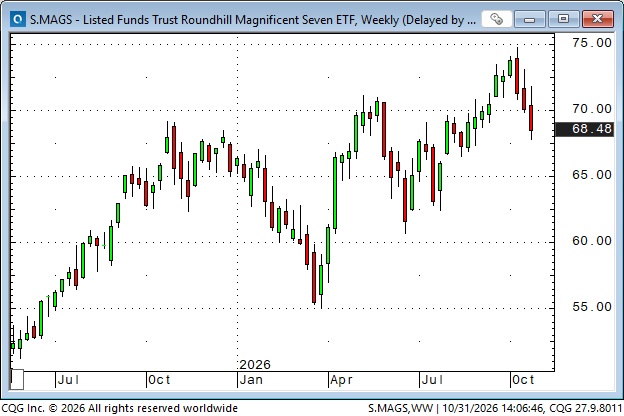
The Magnificent 7 ETF, the MAGS, fell ~9% from the record highs made just 3 weeks ago.
Intel had its worst day in 50 years following its Q3 report.

CAT, which I’ve featured in this blog as a “picks and shovels” play on the datacenter/AI gold rush, had another bad week following “cautious” forward guidance in the Q3 report. CAT is down ~44% from the record highs made in June.

AAPL, which I’ve featured in this blog as a “safe haven” in the Tech space lately because it is “untainted” by AI, has regained its status as the company with the largest market cap (just over $5 trillion). AAPL reports on Monday, November 2. (NVDA reports on November 17. The market reaction to that report could be a pivotal moment for investor sentiment).

META is down ~21% from last month’s highs.

Despite the weakness in the tech sector, the S&P closed October only ~3% below the record highs reached 4 weeks ago.

The S&P equal-weight ETF has closed higher for 4 consecutive weeks, suggesting a “rotation” between market sectors.

XOM and CVX both rallied to new record highs this week following quarterly reports showing “bumper profits.”
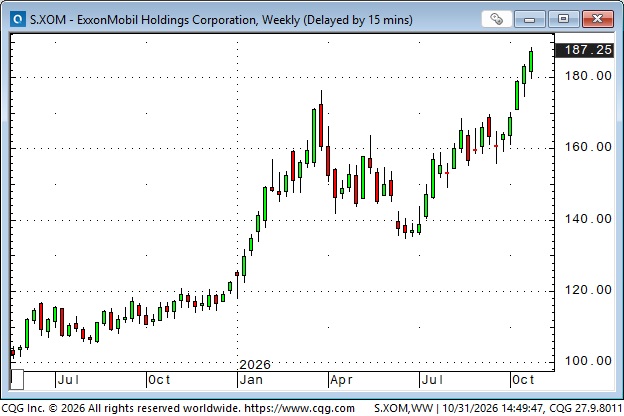
I lifted this chart from The Heisenberg Report, which I’ve subscribed to for several years. If you weren’t watching TV back in the late 1960s, you probably don’t understand the word Clampett. Hint: The Beverly Hillbillies.

About 70% of the S&P stocks have reported as of month-end, and, on balance, the market’s reaction to the tech sector reports has been negative. It seems that the market has swung from chasing the AI dream to worrying that some of the most successful and profitable companies in the world are fundamentally changing their business model from money-making machines with aggressive buyback programs to companies with negative cash flow due to massive capex spending, while taking on massive debt (at increasingly higher spreads over Treasuries) and becoming net sellers of equity.


Surging earnings and profits (and forecasts of much more to come) have been the backbone of the stock market rally over the past couple of years, and most of that growth has come from big-cap tech companies. There has been talk of “rotation” and “rebalancing” between stock market sectors (and perhaps, at the institutional level, rebalancing away from stocks and into bonds), but that rotation may be only a preliminary step before liquidation if earnings and profit expectations fail to materialize.

Households appear to be deeply committed to the equity market.

Energy
Crude oil: Front-month WTI rallied to $105, the highest weekly close since May.

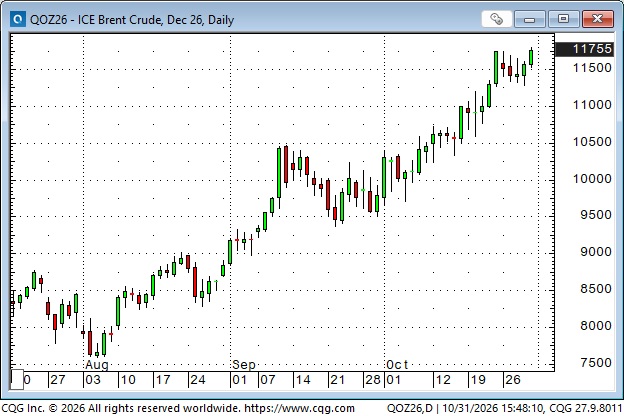
Front-month Brent crude rallied to $118, the highest weekly close since 2022.
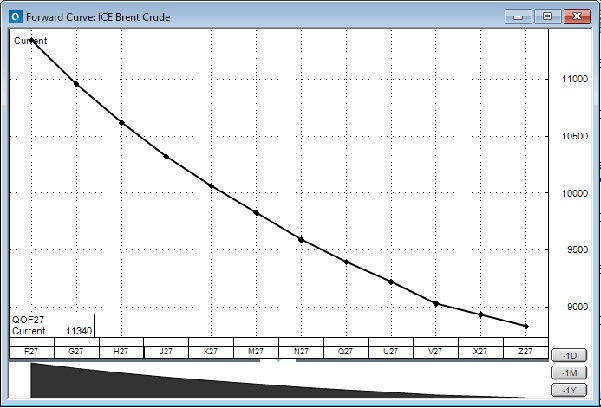
The forward Brent curve has December 2026 trading at a ~$30 premium over Dec 2027. That $30 premium may reflect the “risk premium” in the current market, despite evidence that Middle East oil exports have returned to pre-war levels, as traders worry about military escalation following the US and Israeli elections.
Diesel and gasoline remain near record highs.

Refiner stocks fell after a strong June-to-September rally.
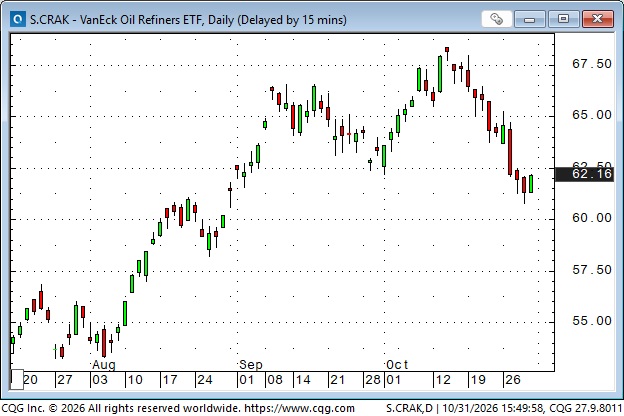
Ukraine hit Russian refineries, Iran attacked shipping in the SOH, while the USA increased military assets in the Middle East.
Natural gas:
Here’s a (lightly edited) comment about natural gas that I made on Substack today in reply to a piece written by Riko Kardamow. I subscribe to Riko and recommend him to my readers.
It is interesting to see that even with US LNG export facilities operating flat out, and with LNG exports expected to increase ~10% in 2027, that Dec 2026 to Dec 2027 (and beyond) NYMEX nat gas futures are trading at life-of-contract lows, down sharply since the start of the war with Iran (blue ellipse on the chart below) when Qatar’s 20% share of global LNG supply went offline.

I appreciate that US net exports are only ~20% of gross production, and domestic use is only forecast to grow by ~2% in 2027, while domestic production (primarily Permian+Haynesville) is forecast to grow faster than domestic use. It looks like the “price” of US nat gas is set by the domestic supply/demand market with little regard for international prices. (What an arb!) COT data as of Oct 27 shows a sharp increase in net short managed money/large spec accounts to a new record high.
Gold and silver are sharply lower
Gold is down ~$850 in 2 months, down ~$1,700 (30%) from the record highs made in January to 12-month lows.

Silver is down ~$23 in 2 months, down ~$70 (60%) from the record January highs.

I remember losing my shirt trying to sell gold in Canada in 1974 when it was trading under $200 per troy ounce. (Americans were prohibited from owning gold then, but that changed on January 1, 1975).
I became a commodity broker in 1976 and traded gold as it raced to record highs of ~$850 in January 1980 as the Russians invaded Afghanistan. Silver soared even more, reaching ~$50. The collapse from those highs was swift and dramatic, and gold did not make new (nominal) highs for 28 years. It took 45 years to make new inflation-adjusted highs.

I reference January 1980 because, on a few occasions since January of this year, I’ve written in these Notes that the chart patterns of those two Januaries were very much alike (and the “public mood” at both of those highs was very similar), and therefore, it may be many years before we see gold and silver trading above this year’s highs.
Currencies
The Brazilian Real jumped higher in early October (blue ellipse) when Bolsonaro did better than Lula in the preliminary round of the federal elections, but collapsed when Lula prevailed in Sunday’s 2nd round (pink ellipse).

The Mexican peso fell more than 10% against the US dollar over the past 7 weeks as the premium of Mexican short-term interest rates over American rates shrank, unwinding the carry trade. (Google the tequila crisis of 1994 to see a massive decline of the Peso against the USD).

The Canadian dollar has sustained and added to its rally off the October lows as the US short-term interest rate premium over Canada shrank from ~170 to ~140 bps. Higher oil prices may have helped (a bit) to buoy the CAD.

The Yen has been relatively quiet for the past 6 weeks after spiking on intervention in July and (unofficially) September.

The Euro has fallen to 18-month lows against the USD. I’ve said many times that I could be short the Euro on Europe’s energy policies alone, so I’m (mildly) embarrassed that I haven’t profited from shorting the Euro.

I think the BIG question in the FX markets is, “Will the USD weaken if US stocks continue to fall?” I think it would, all else being equal, which is never the case. Capital has flowed to the US for the unique opportunities in the US equity markets, and those flows could reverse. I think if capital repatriates from the US, the bigger flows would go to Japan.
My short-term trading
I started this week short copper, a position I established early last week. I had lowered my stop when copper dropped to ~$6.40 to lock in a profit if the market bounced back. The market bounced, and I was stopped for a modest gain early Tuesday. I got short again on Thursday and held that position into the weekend as copper fell hard on Friday. I’m short copper as a play on AI fading. I also think China is in a balance-sheet recession, and it accounts for 50% of annual copper demand. Neither idea has much day-to-day impact on copper, but if the market takes out the September lows, the decline could accelerate.

I bought both the Euro and the CAD on Wednesday. My CAD gains were offset by losses on the Euro.
I shorted the S&P on Thursday after the market turned lower on Wednesday and covered the trade (too early) on Friday for a nice gain.
The only trade I held into the weekend is a short copper position.
On my radar
APPL reports on Monday.
The US midterms are on Tuesday. Polymarket has the Dems winning the House at 95%, winning the Senate at 72%. People elected on November 2 take office on January 2, so the House and Senate may have a 2-month “lame duck” period.
Quote of the week
“You think you make a (trading) decision based on some analysis. You don’t. You make the decision on how you feel about the analysis, your confidence in the outcome that you’re predicting. ” Denise Shull, trading coach”
The Barney report
We’re into the rainy season here, so I’ve been putting Barney’s “raincoat” on him when it’s wet outside. He doesn’t really like it, but if it means we’re going out, he puts up with it.

Listen to Mike Campbell and me discuss markets
On this week’s Moneytalks show, Mike and I discussed the stock market break, especially in AI-related stocks. We also talked about oil and the steep decline in gold and silver. You can listen to the entire show here. My spot with Mike starts around the 57-minute mark.

Listen to Jim Goddard and me discuss markets
I did my monthly 30-minute interview with Jim yesterday. We started talking about the stock market but also discussed crude and natural gas, gold and silver, copper, bonds, currencies and the elections – here in BC, but also Brazil, Israel, and the upcoming midterms in the USA. You can listen to the full show here. My friends Ross Clark, a veteran technical analyst, and Josef Schachter, a renowned oil analyst, are also on the podcast with Jim Goddard. My spot with Jim starts around the 10-minute mark.

The Archive
Readers can access any of the weekly Trading Desk Notes from the past six years by clicking here.
Subscribe: You have free access to everything on this site. Subscribers receive an email alert when I post new content, typically four to six times a month.
Victor Adair retired from the Canadian brokerage business in 2020 after 44 years and is no longer licensed to provide investment advice. Nothing on this website is investment advice for anyone about anything.