
US interest rates surged higher this week.
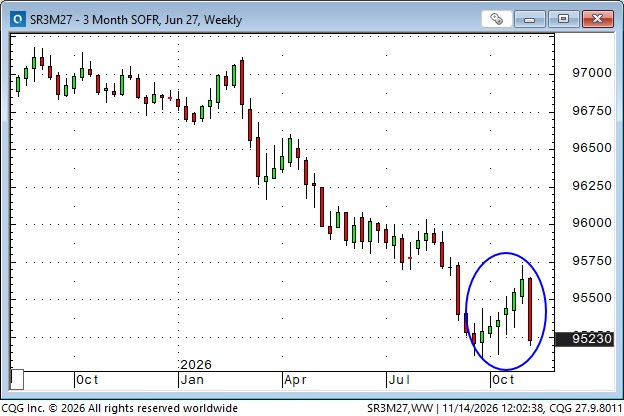
The June 2027 SOFR futures took six weeks to rally ~50 bps (from ~9525 to ~9575), then gave it all back this week as Fed speakers (led by Governor Waller) proposed bigger, faster hikes for the FOMC and CPI came in hotter than expected. The forward market is pricing ~26 bps of tightening by the December 9 FOMC meeting, and nearly 80 bps by the June 9, 2027 meeting.
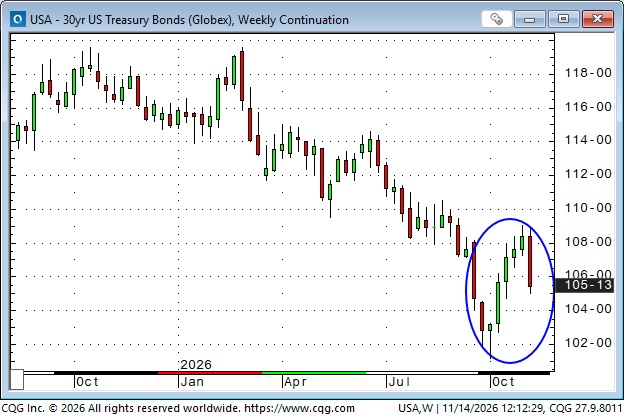
The December 30-year bond futures rallied 9 handles from the early October 24-year lows to last week’s highs, but gave back 50% of that 5-week rally this week.
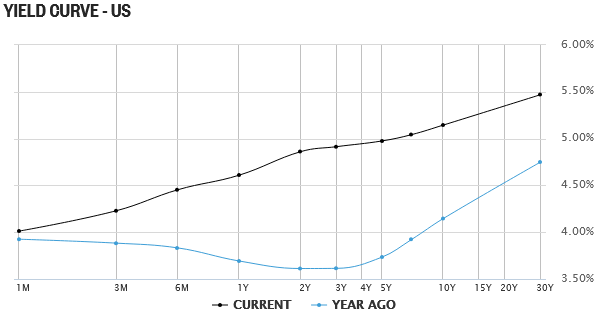
The yield curve is higher and flatter than where it was a year ago.
Last week’s stronger-than-expected employment data capped the 5-week rally off the early October lows, and this week, in addition to comments from FOMC members and the CPI data, negative news about the outlook for the US fiscal deficit and poorly received bond auctions also weighed on prices. Friday’s PPI report was near expectations, but at 6.5% YoY on the headline number and 5% YoY on the core, it did not generate new buying, and markets closed near the week’s lows across the curve.
People taking a bullish view on bonds have argued that the CPI and PPI data are “stale” and don’t account for the recent ~20% decline in crude oil prices. These folks characterize the Fed as, once again, playing “catch-up” and looking to raise rates when it should be standing pat or cutting.
Sharply higher US interest rates boost the USD
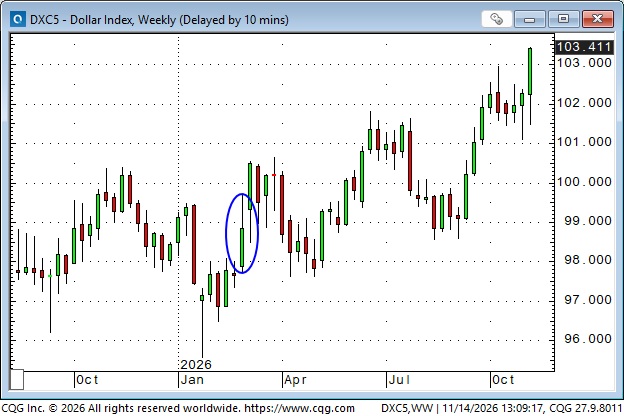
The DXY US Dollar Index closed at a 19-month high this week, up over 8% from the 4-year lows reached in January. The stronger-than-expected CPI report on Tuesday (blue ellipse) triggered this week’s rally, which gained strength as it rose above the October highs.
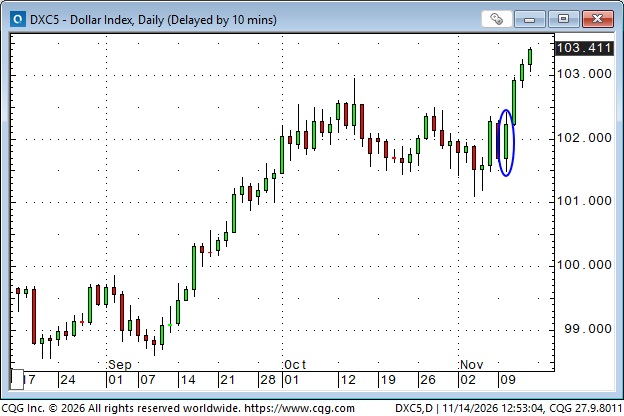
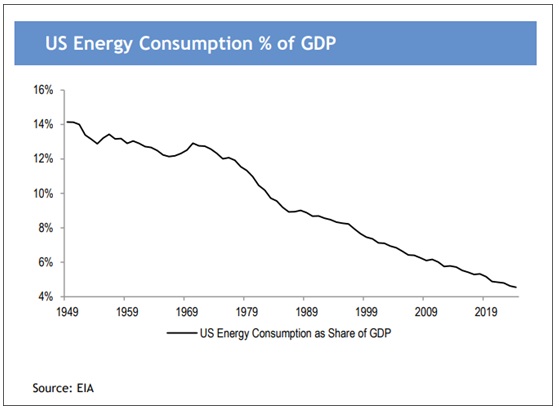
The US Dollar Index has been “stair-stepping” higher this year after surging to 3-month highs (blue ellipse) at the start of the war with Iran. American energy self-sufficiency helped boost the USD, and as rising energy costs boosted inflation, US interest-rate differentials relative to other countries gave the USD another boost. The “cherry on top” (and it is a very big cherry) has been massive foreign capital inflows chasing opportunities in the US equity markets. Net USD speculative bullish positioning in currency futures has been strong, but not “over-the-top” strong.
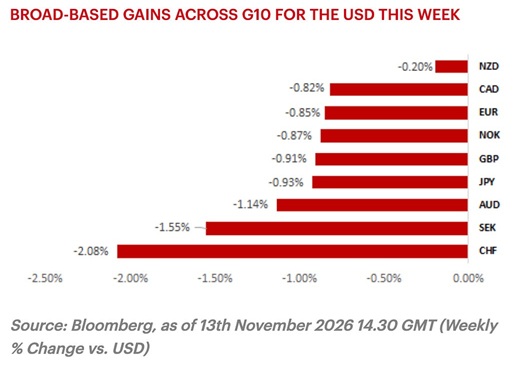
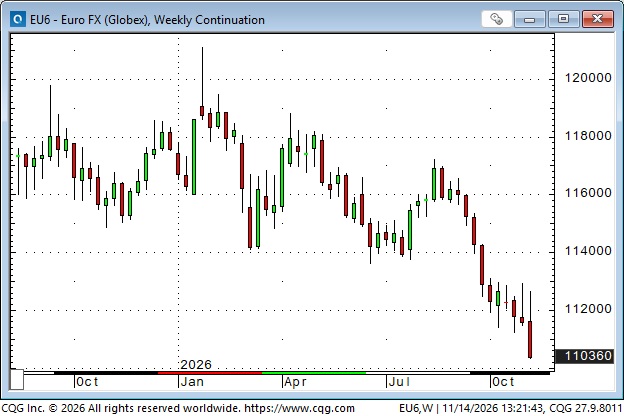
The price action in the Euro has been the virtual “mirror image” of the DXY USD Index this year, reaching a 5-year high in January, falling sharply at the start of the war with Iran, and closing this week at 19-month lows. Net Euro bearish speculative positioning was at an 11-year high before this week.
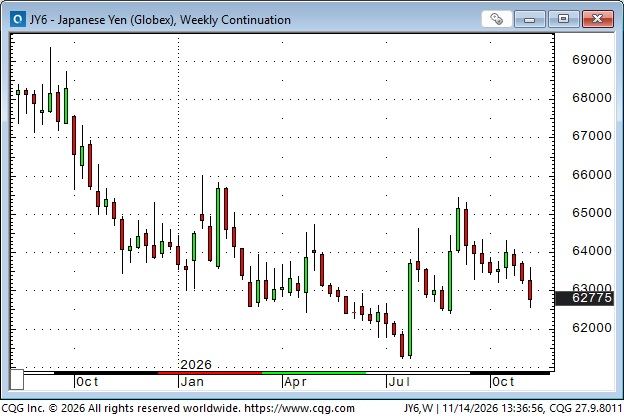
The Japanese Yen hit 40-year lows against the USD in July, down ~54% from the all-time highs reached in 2011-12. Two rounds of intervention rallied the Yen above 65 by September, but since then the Yen, like virtually all other currencies, has weakened against King Dollar. Net speculative positioning in the Yen turned mildly bullish in the past few weeks, perhaps on expectations of another round of intervention from Japanese authorities. (The Yen is the only currency future with a net speculative bullish position vs. the USD.) Another sign of the USD’s strength: the Yen (and the Euro) weakened even as crude oil prices fell ~20% over the past two weeks.
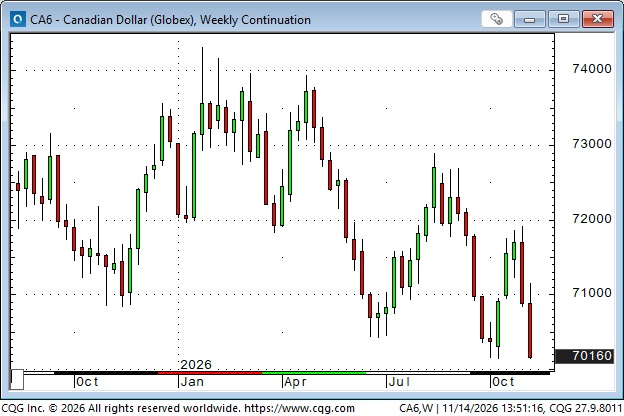
The Canadian Dollar briefly traded at 17-month highs in January when the USDX was at its lows, but since then the CAD has “stair-stepped” lower, closing this week at 20-month lows. US interest rate premiums have weighed on the CAD this year, with the 2-year spread over 150 bps on Friday. Net speculative positioning in the CAD was mildly bearish before this week.
Equities
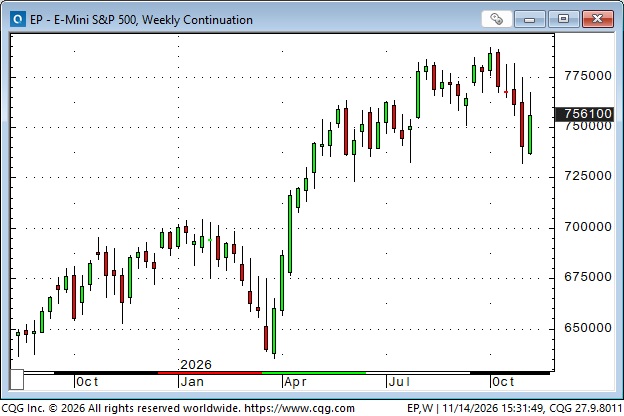
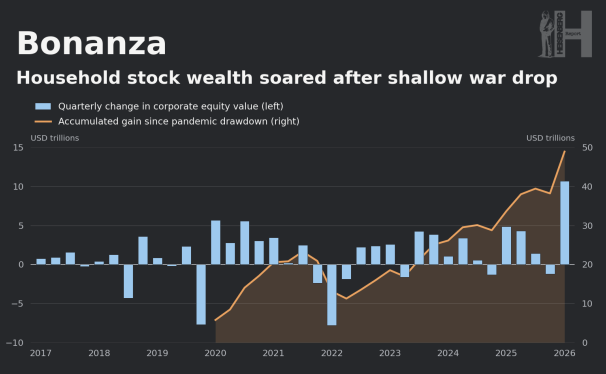
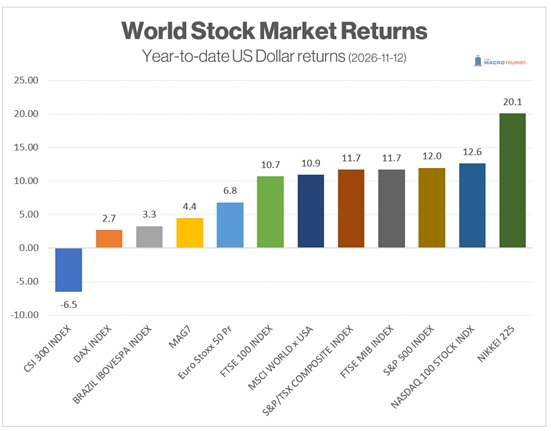
S&P futures reached record highs on October 6, then fell for 4 consecutive weeks, down ~7% at last week’s lows. The index rebounded this week to close ~4% below the record highs. At this week’s close, the S&P market cap was down ~$2.3 trillion from the record high of ~$70 trillion on October 6.
NVDA also reached a record high on October 6, then fell for 6 consecutive weeks, down ~38% at this week’s lows. At this week’s close, NVDA’s market cap was down ~$1.85 trillion from the record high of ~$5.77 trillion on October 6. The NVDA quarterly report is due Tuesday, November 17.
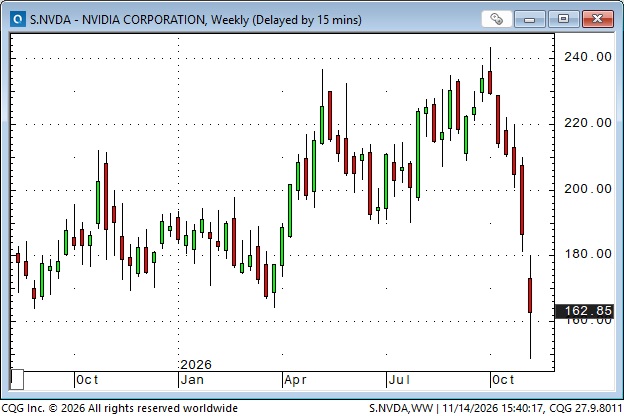
If you haven’t already done the math in your head, NVDA’s market cap loss was ~80% of the total S&P market cap loss. Talk about concentration.
Supply
Wall St. analysts are estimating that the net supply of stock in 2027 will be the greatest since 2000. Corporate buybacks will be reduced, and in addition to IPOs and secondary offerings, GS reports that ~$1.7 trillion worth of stock will be available for sale as “lock-ups” expire.
ANT (Anthropic) is expected to price its IPO on Wednesday, with shares starting to trade on Thursday. The IPO could be the largest in history.
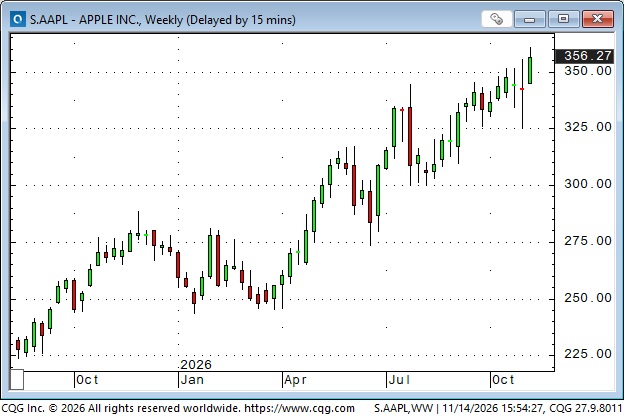
AAPL reached another record high this week, with a market cap of ~$5.18 trillion, and it remains a “safe haven” in the tech sector, “untainted” by AI concerns.
Metals
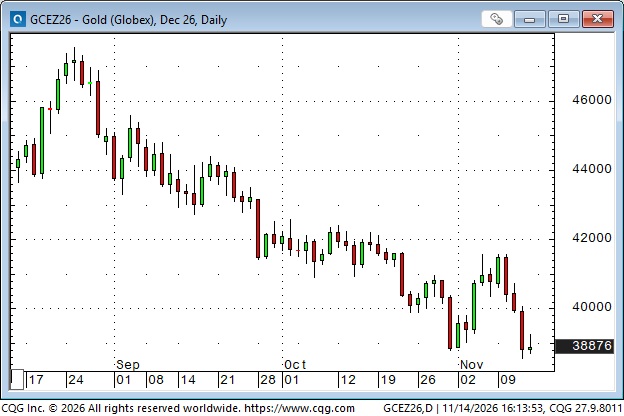
The gold market rally that started last week topped out on Monday, up ~$270 from the lows. In a move that must have surprised many veteran gold traders, gold fell sharply on Tuesday after the CPI report showed higher-than-expected inflation. As noted above, interest rates jumped on the CPI report, and higher rates boosted the USD, so the combination of higher rates and a stronger USD pressured gold to 14-month lows.
Central bank buying has been the “core” support for the gold market since the Russian invasion of Ukraine in 2022. However, this week reports suggested that the Reserve Bank of India, which bought ~50 tonnes of gold in the first 9 months of 2024 and 4 tonnes in the first 9 months of 2025, purchased only 0.3 tonnes in the same period this year.
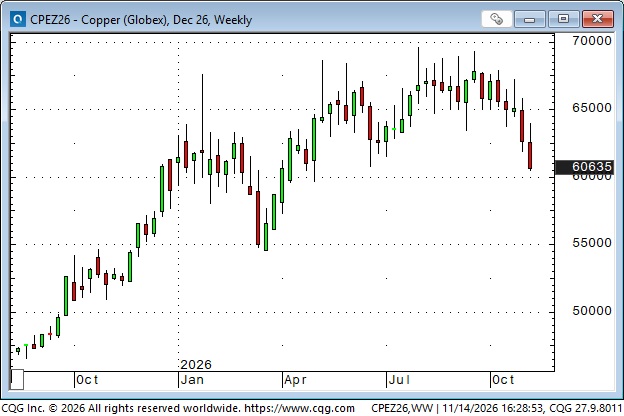
COMEX copper prices spiked to nearly $7 a pound in early August when the “electrification of everything” bullish narrative peaked. Over the past 5 weeks, copper has fallen nearly 75 cents (11%), perhaps due to “second thoughts” about data center demand.
Energy
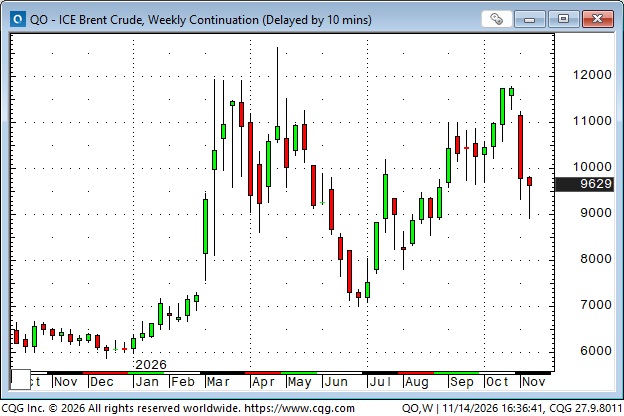
Front-month Brent futures dropped as much as $25 from late October highs to this week’s lows as the “risk premium” came out of the market on messages from Trump and Rubio to the effect that there was “no need” to attack Iran, even though Iran is continuing to “harass” shipping in the SOH. Iran has declared that it has “no interest” in agreeing to end the war on American terms.
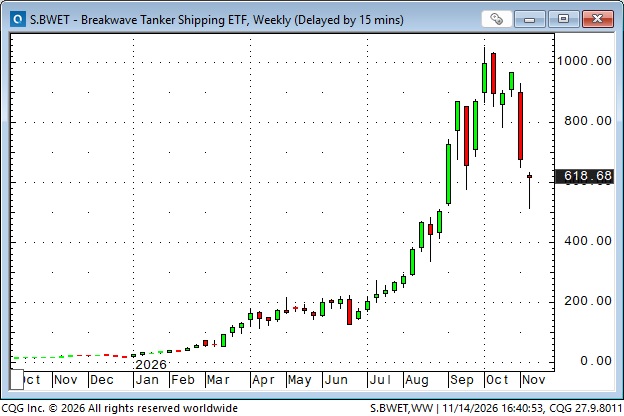
The ETF for tanker shipping rates has fallen as much as 50% from early October highs, although prices are still substantially higher than before the war with Iran began.
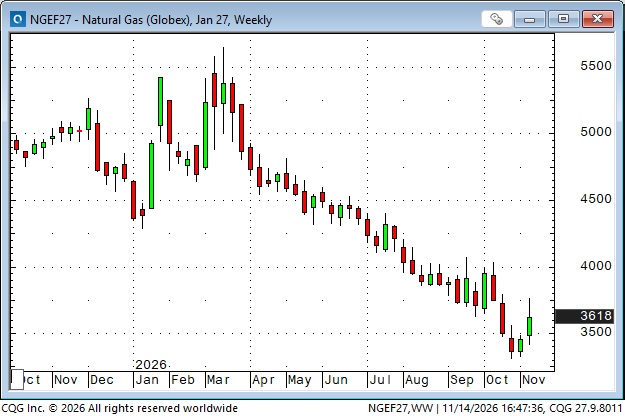
NYMEX natural gas for January 2027 perked up a bit in the past 2 weeks after falling ~40% since the start of the war with Iran. Net bearish speculative positioning reached record highs last week.
Trump, Xi and Putin are expected to attend the APEC meeting in Shenzhen, China, on Wednesday and Thursday. Energy markets could react to news if they meet.
My short-term trading
I started this week flat, with no positions held over from last week.
I bought the Yen after it bounced back from a down day last Friday, but it didn’t rally, so I covered for a slight loss.
I shorted the S&P twice on Tuesday when it looked like Monday’s rally had run out of steam. I took tiny losses on both trades and decided to buy the market instead of shorting it. That turned out to be a good idea, and I covered the trade for over a 100-point gain early Thursday.
I wrote 10-day puts on the 30-year bond near the lows on Tuesday after the market had dropped nearly 2 handles from last Friday’s highs. The trade looked OK Wednesday and early Thursday, but the market fell away on Thursday, and I covered the trade for a loss nearly the size of my gain on the S&P.
My net P&L was unchanged on the week, and I was flat into the weekend.
Quote of the Week
This is a steal from a Kevin Muir post this week. Kevin is quoting our mutual friend Dennis Gartman.

The Barney report
This time of the year is rutting season for the black-tailed deer that live around here. The bucks come down from the mountains, hook up with the does and go back to the mountains by the end of December. The bucks can get a little rambunctious and dangerous during this time. A couple of days ago, Barney and I saw a good-sized buck on the golf course. He didn’t run away from us, as the does usually do, and I was glad I had Barney on a leash; otherwise, he might have run at the buck and gotten hurt. Here’s Barney in a contemplative mood with his newest stick.

Listen to Mike Campbell and me discuss markets
On this week’s Moneytalks show, Mike and I discussed the sharp increase in interest rates and how that impacted the currency and metal markets. We also talked about stock and energy markets. You can listen to the entire show here. My spot with Mike starts around the 50-minute mark. Be sure to listen to our featured guest, James Thorne. He and I don’t always agree on markets, but I have great respect for him. He will be one of the speakers at the next World Outlook Conference. His spot with Mike starts around the 6-minute mark.
The 38th Annual World Outlook Financial Conference
Mike and his team will host another great conference at the Bayshore Hotel in Vancouver on February 5 and 6, 2027. I will be the opening speaker on Friday afternoon and will help Mike with MC duties on Saturday. I look forward to meeting many of my subscribers at the conference. Please don’t be shy to say hello.
The conference has a terrific lineup of speakers and presenters; click here to access all the information you need and to register to attend.

The Archive
Readers can access any of the weekly Trading Desk Notes from the past six years by clicking here.
Subscribe: You have free access to everything on this site. Subscribers receive an email alert when I post new content, typically four to six times a month.
Victor Adair retired from the Canadian brokerage business in 2020 after 44 years and is no longer licensed to provide investment advice. Nothing on this website is investment advice for anyone about anything.