
The S&P 500 index appeared to drift quietly sideways for the last several weeks. However…
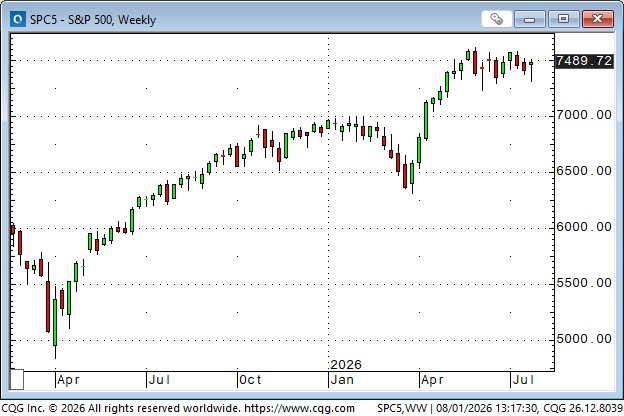
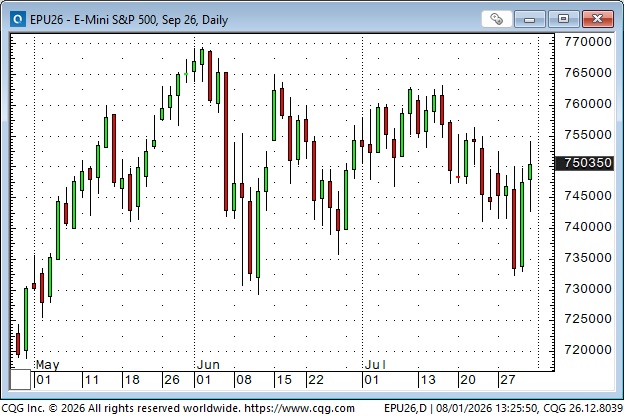
Stock index futures experienced very volatile short-term price action, and there was even more volatile price action in individual names and sectors. The volatility is due, in part, to over-leverage, momentum, crowding and concentration.
Here’s the S&P futures daily chart for the last three months: that’s choppy!
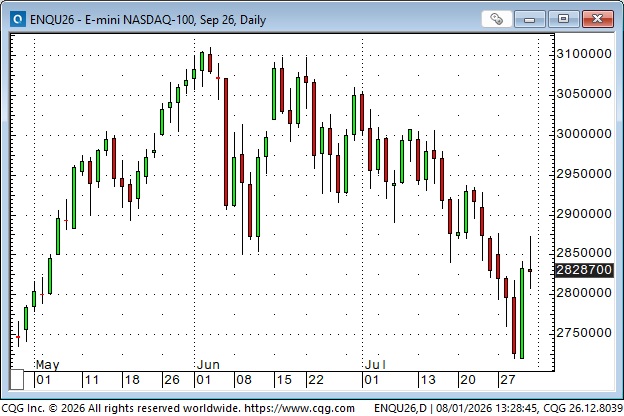
Nasdaq futures were weaker than the S&P due to a higher tech weighting.
The semiconductor index ETF.
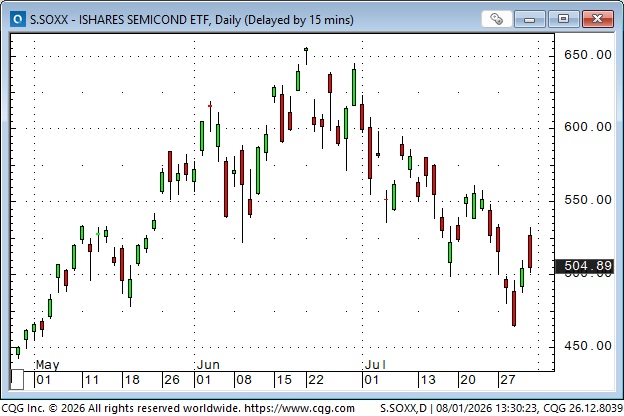
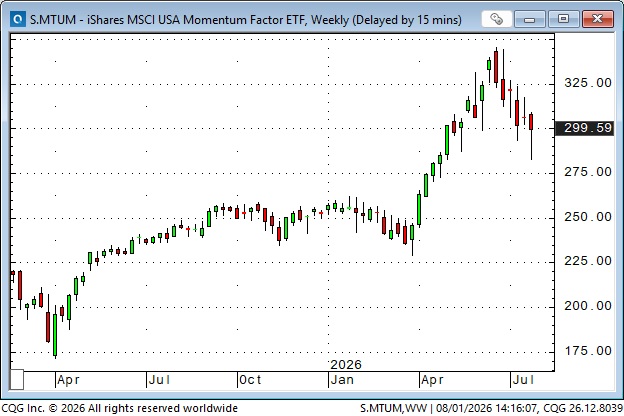
The Momentum trade soared ~50% from March to June, but has “unwound” over the last 6 weeks.
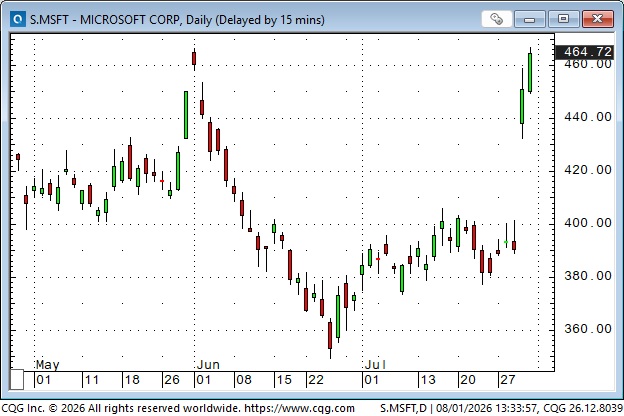
MSFT
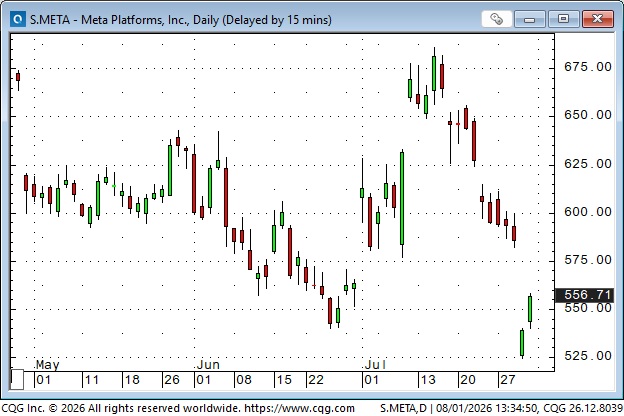
META
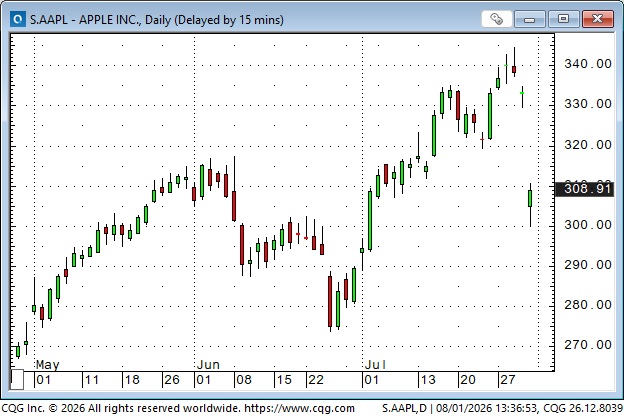
AAPL – market cap down ~$600 billion from Wednesday’s record highs to Friday’s lows. AAPL has been a “haven” within the tech sector (as capital “rotated” to AAPL and away from falling AI stocks) with the share price surging ~24% from June lows to July highs, reaching a market cap of over $5 trillion. The share price fell after a poorly received Q2 report on Thursday, and fell further on Friday as capital “re-rotated” out of AAPL and back into the stocks that had been falling like a stone earlier in the week.
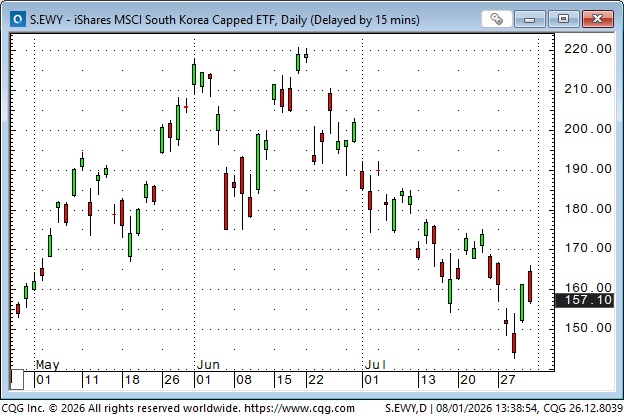
The MSCI South Korea ETF. Two memory stocks (Samsung and SK Hynix) “became” the index with millions of over-leveraged retail accounts bidding the index up by ~80% from April to June. The index gave back ~2/3 of those gains over the last 6 weeks.
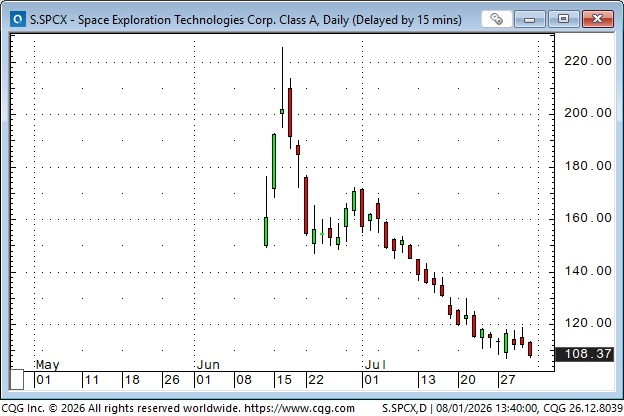
SpaceX fell over 50% from the post IPO highs to Friday’s close.
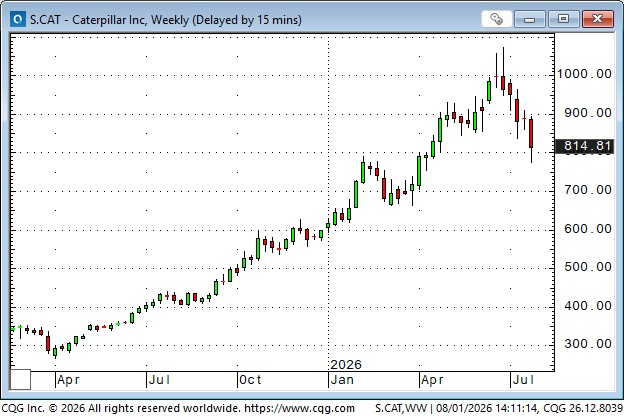
CAT shares soared ~4X from the April 2025 lows to this June’s highs, then tumbled ~28% to this week’s lows. I saw CAT (providing power generation equipment for data centers) as a great example of the “picks and shovels” industries that benefited from the AI boom.
This week’s “defining moment” was the blow-up of Situational Awareness, a hedge fund that lost billions of dollars after making leveraged bets on AI tech stocks. (Google it; there are a hundred stories). Citadel scooped up the fund’s publicly traded shares at a discounted price, and that caused tech shares that had been falling like a stone to reverse and surge higher. The margin clerks sold the lows. Again.
Here’s a photo of the young man (he’s 24) who was running the fund. He was something of a legend in the AI world, but didn’t have much trading experience.

Interest rates
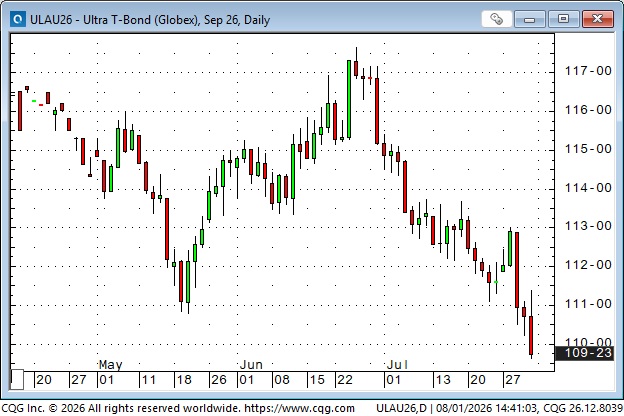
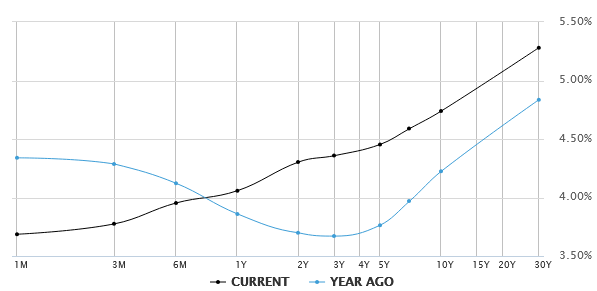
The FOMC did not raise short-term interest rates on Wednesday, and the 30-year bond yield soared to 20-year highs of ~5.28% by Friday’s close. Are the “bond vigilantes” testing the new Fed Chair?
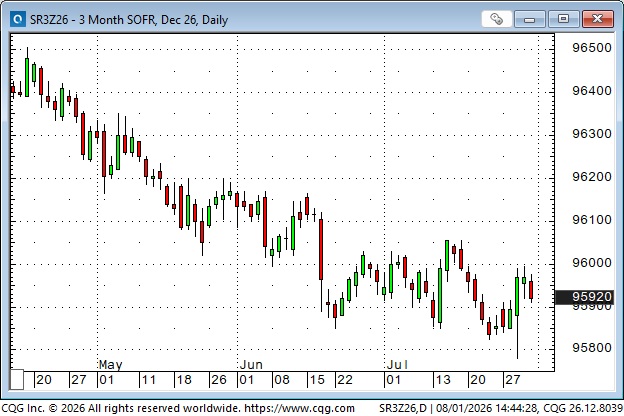
Short rates had a more subdued reaction, with the December 3-month SOFR contract pricing rates 50bps higher by year-end.
The yield curve as of Friday
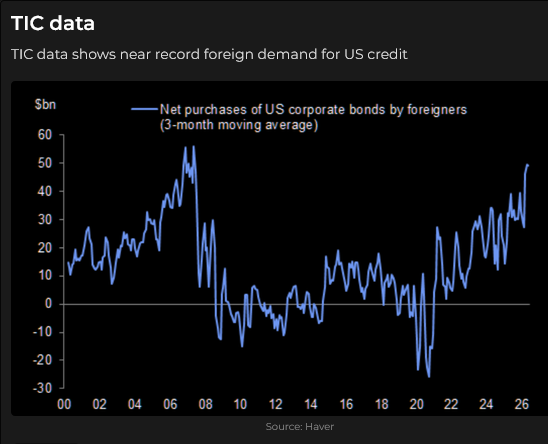
Currencies
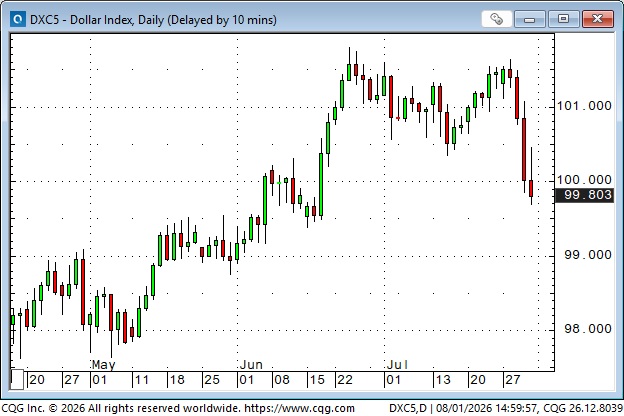
Before the FOMC meeting, the market was pricing a ~30% chance that the Fed would raise rates. COT data showed that speculators in the currency futures markets were heavily long the USD (that positioning had been building for the past few months as the USD rallied), with the premium of US interest rates over most other currencies being a significant factor. The USD fell on the FOMC news and continued to fall further on Thursday and Friday.
The Japanese Yen soared in the Wednesday overnight market as the Japanese authorities intervened in support of the Yen, which had fallen to 40-year lows. The initial intervention saw the Yen rally ~200 points and then fall back ~100 points. Subsequent intervention (or perhaps short-covering) and reports that the NY Fed may have been involved (the FT reported that the NY Fed bought Yen against the Euro) created a second leg higher, with the Yen closing the week at 12-week highs.
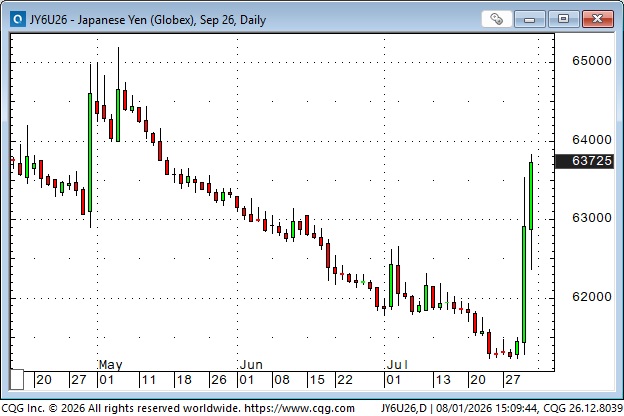
The EUR/YEN closed the week at 6-month lows.
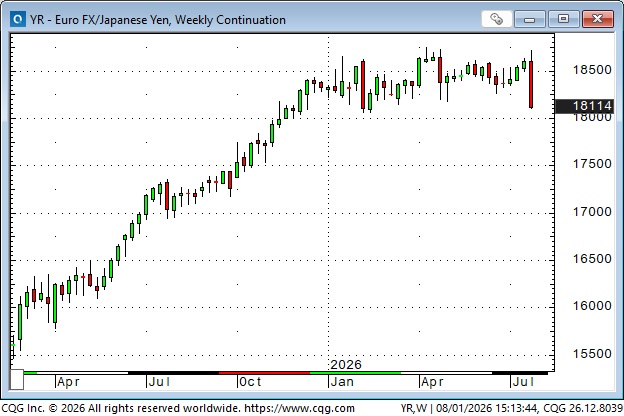
I have written about a possible turn higher in the Yen several times over the past year. The Yen is down over 50% from its 2011/12 record highs against the USD, but I believe once it finally turns, it will begin a multi-year rally (rising against other currencies more than it rallies against the USD). Intervention over the last few years has temporarily boosted the Yen, but has not created a “durable” low because fundamental policies in Japan need to change. The government runs a huge fiscal deficit, and the BoJ keeps bond yields artificially low. A weakening Yen has been a “pressure valve” in this environment. If the new Takaichi government can demonstrate that Japan is on a “new path” and if repatriation flows begin, then the Yen may start a self-sustaining rally. I think there’s a good chance that “the lows have been made” this week (markets are forward-looking), but “real money” accounts will be cautious and slow to move.
Sunday morning edit: It occurred to me in the middle of the night that there might be a correlation between the turn higher in the Yen this week and bond yields rising to a 20-year high.
2nd Sunday morning edit: I just finished reading a terrific new essay by Michael E. Green on the relationship between the Yen and global bond markets. He is certainly an “academic”, but the essay is written in “plain English,” and clearly makes the point that the markets are highly correlated. I subscribe to his Substack, but I think there is free access to this essay. (If not, the content he produces is well worth the modest subscription fee.)
Energy
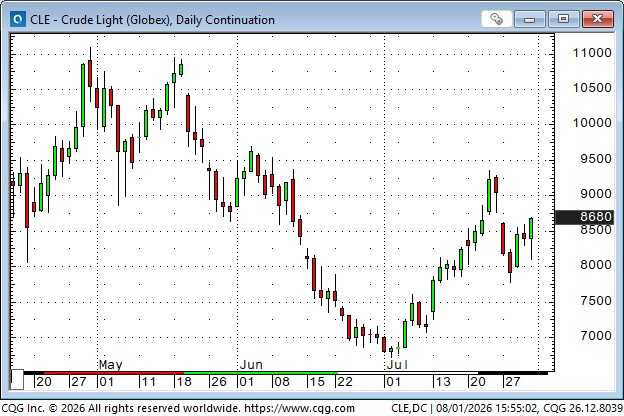
NYMEX front-month WTI futures had fallen to pre-war levels around $70 in early July before surging to ~$93 over the next three weeks as US/Iran hostilities flared. (Brent futures hit a high of $102). WTI dropped as much as $15 from last week’s highs to Tuesday’s lows on hopes of renewed negotiations, but renewed hostilities caused prices to rally, and the market closed the week on the highs with Trump threatening “heavy” attacks on Iran this weekend.
Saturday night edit: Trump calls off planned “heavy” attack – cites John Lennon’s song “Give Peace A Chance.” I don’t know about you, but this feels more and more like Lucy and the football.
Product prices, especially diesel, stayed higher as global refinery capacity has been significantly reduced.
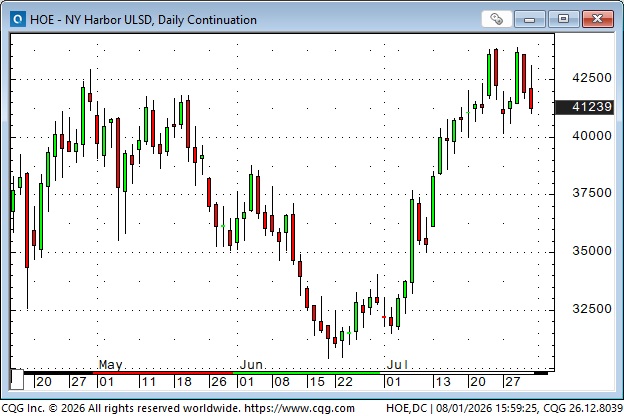
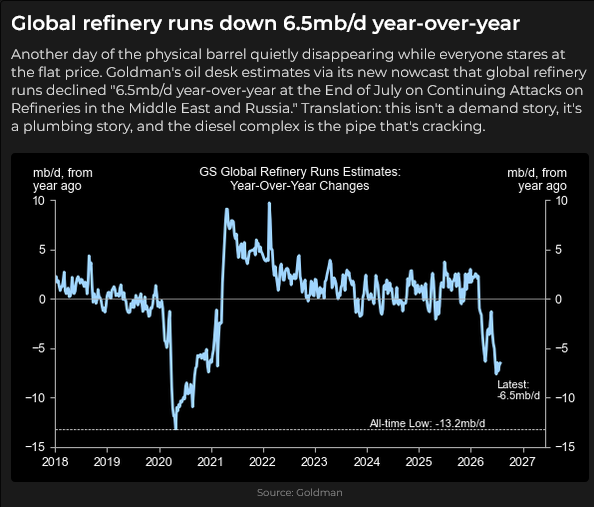
A widening war in the Middle East (and/or Russia/Ukraine), combined with lower reserves, could see crude and products trade above this year’s highs. Ukrainian attacks on Russian refineries have caused Russia to stop exporting diesel and gasoline, leaving Europe short on transportation fuels in addition to being short of natural gas supplies due to Hormuz closures. As Doomberg writes in his July 31 post, “It could be a doozy of a 2026-2027 winter for Europe.”
Cross-market summary
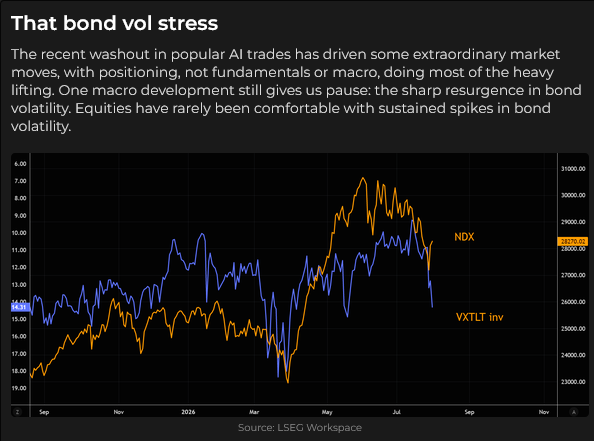
The equity indices have experienced heightened short-term volatility tied to “wild” VOL in the tech sector, yet stocks seem oblivious to the Iran war and bond yields rising to 20-year highs. If the Yen really has made a low and starts to work higher, that will impact global carry trades and may shake the Jenga tower of leverage that has fuelled the bull market in risk assets. If the Iran war and the Russian/Ukraine war continue to grind on, let alone widen, energy price increases will put additional pressure on risk assets.
My short-term trading
I started this week with no positions held over from last week. I shorted the S&P on Monday and Tuesday and was stopped each time for slight losses, and I missed Wednesday’s big break. I shorted OTM bond puts on Thursday after the long bond fell about 2 full points on Wednesday/Thursday, but covered the position on Friday for a slight loss as bonds continued lower. I was flat at the end of the week.
The hit to my P&L this week was less than 1%, and my losses in July were only a little more than that, but I have been in a “slump” in July as I try to navigate these volatile markets.
I should mention that I “grumbled” on Thursday morning when I saw the Yen nearly 200 points higher after I had covered the last of my long Yen positions last week. When you’re cold, nothing works.
Thoughts on trading
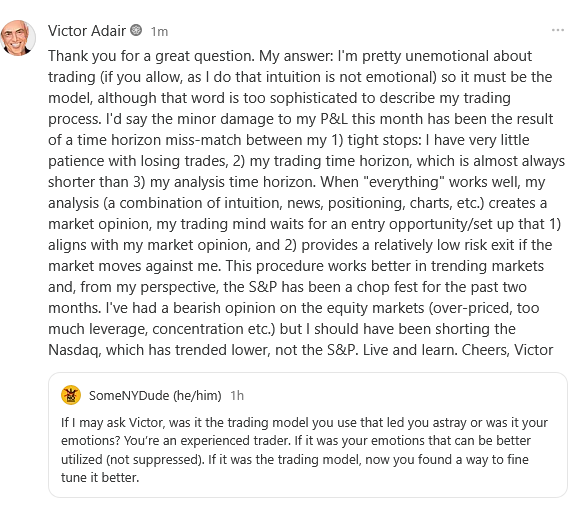
Here’s a quote from my Substack Notes in reply to a question about my trading process (The question is below my answer).
The Barney report
Barney will be five years old next month. He weighs ~80 pounds and is truly a happy dog, but he’s learned how to get my attention by wimpering. I tell him that’s for baby dogs, not for Big Dogs like him, but he keeps doing it, probably because Papa keeps responding. Who’s teaching who? Here he is, striking a pose outside our front door.

Listen to Mike Campbell and me discuss markets
On this week’s Moneytalks show, Mike and I discussed the blow-up of the Situational Awareness hedge fund, the wicked short-term VOL in the equity markets, bond yields surging to 20-year highs and the intervention in the Japanese Yen. You can listen to the entire show here. My spot with Mike starts around the 51-minute mark.
The Archive
Readers can access any of the weekly Trading Desk Notes from the past six years by clicking here.
Subscribe: You have free access to everything on this site. Subscribers receive an email alert when I post new content, typically four to six times a month.
Victor Adair retired from the Canadian brokerage business in 2020 after 44 years and is no longer licensed to provide investment advice. Nothing on this website is investment advice for anyone about anything.