
The US Treasury Secretary said something about the bond market, and gold jumped $300
Traders expected this week to be “relatively quiet”; it’s mid-August, most senior staff at financial firms are on vacation, and the calendar was light. But at 8:30 am (NY time) on Wednesday, the Treasury Secretary announced a bond-buying program to provide liquidity for “off-the-run” long-dated bonds. Although the amount of money involved was tiny, the market reaction was huge.
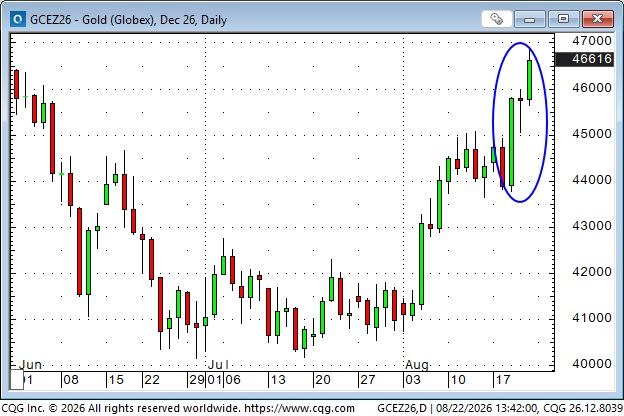
Gold jumped about $300 from Bessent’s announcement early Wednesday morning to Friday’s highs. Month-to-date, gold is up ~$600 (~15%) to 3-month highs.
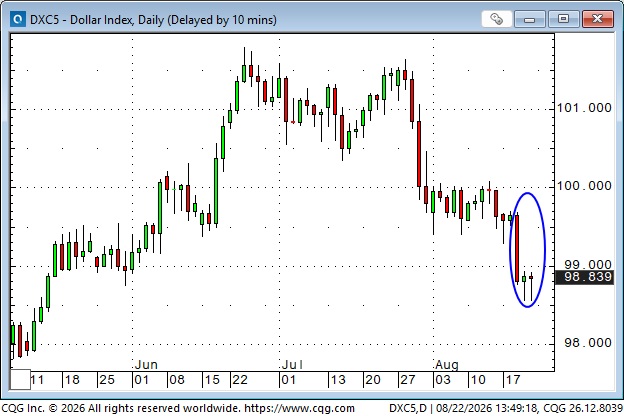
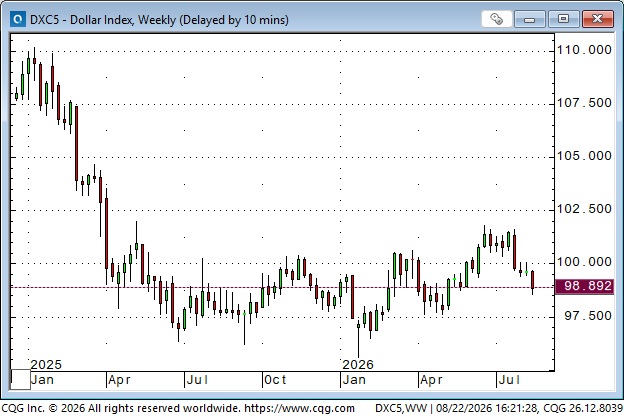
The DXY US Dollar Index fell ~1% from Wednesday’s announcement to Friday’s lows and is now down ~3% month-to-date, at 3-month lows.
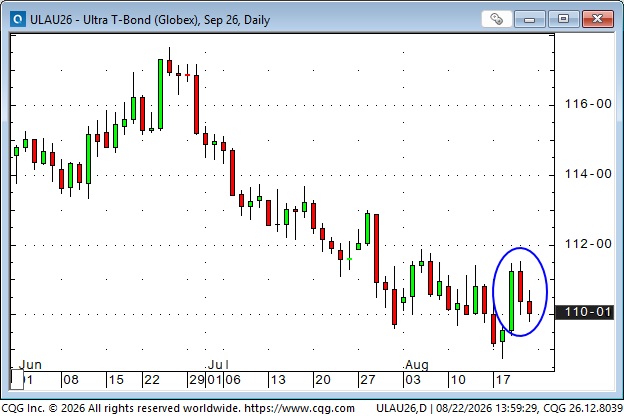
Long bond futures traded to (effectively) 19-year lows on Tuesday (the cash market yield on the 30-year was ~5.33%), then rallied hard on Wednesday after the announcement, only to give back most of those gains by Friday’s close.
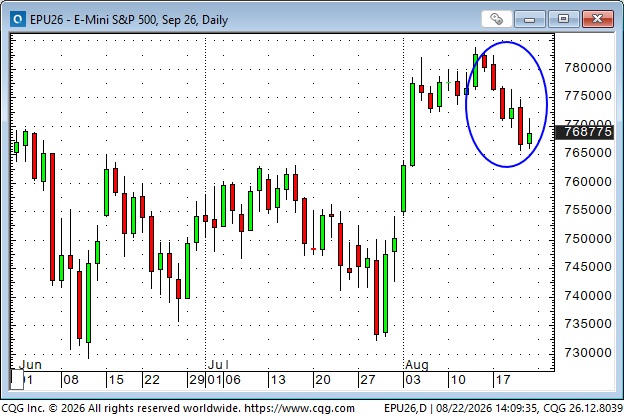
The S&P rallied to all-time highs on Thursday last week, closed slightly lower on Friday, fell more on Monday and Tuesday, had a half-hearted rally on Wednesday following the Treasury announcement, but then took another leg lower on Thursday.
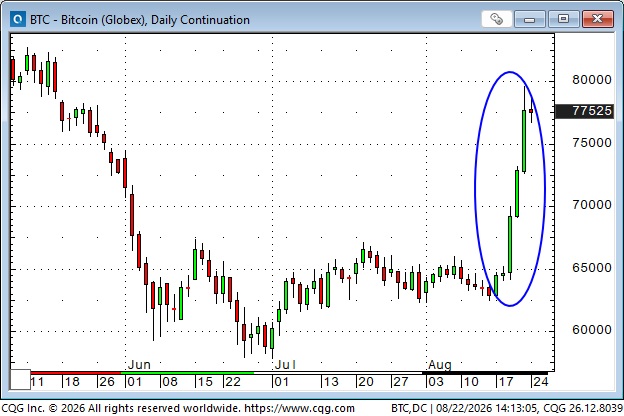
Bitcoin soared to three-month highs.
So, what happened?
I sat down at my trading desk a few minutes before the Treasury announcement (5:30 am West Coast time) and scrolled through different markets. Everything had been pretty quiet overnight. Suddenly, dramatic price changes hit all the financial futures I follow. I wondered what had happened (nothing serious was scheduled), and I quickly found news of the Treasury announcement. My first thought was that the announcement was a “nothing-burger.” Providing a few billion dollars to “tidy up” orphan long bonds was no big deal, but market price action said otherwise.
I knew futures market speculators were heavily net short the bond market and heavily net long the USD (they were also net long gold and had increased that positioning in the past two weeks, but it was not “out-sized” relative to the past few months) and covering those speculative positions would likely move markets.
I scrolled through Twitter and quickly found comments to the effect that the Treasury had panicked with bond yields near two-decade highs, and this was the beginning of yield curve control. Well, that’s Twitter, right?
Remember, we were in the heart of “August vacation time”; senior staff were away, and prices were moving quickly against heavily leveraged positions in currencies and Treasuries.
The flow of opinion from market analysts became a torrent over the next few days, heavily weighted toward the Treasury announcement as a watershed moment and the idea that the time had come to “pay the Piper” after years of fiscal profligacy.
For a much more nuanced view on the credit markets, I invite readers to check out this essay written by Lance Roberts from Real Investment Advice in Texas.
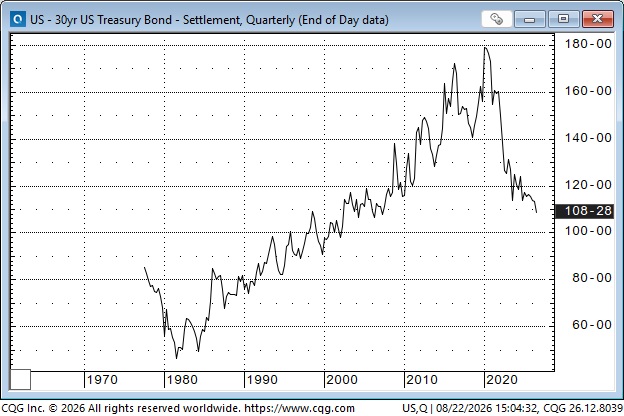
This chart of the 30-year Treasury bond futures (the contract first traded in 1977) spans most of my trading career, and you can see that over the past 50 years we’ve spent more time with bond prices below today’s levels than above.
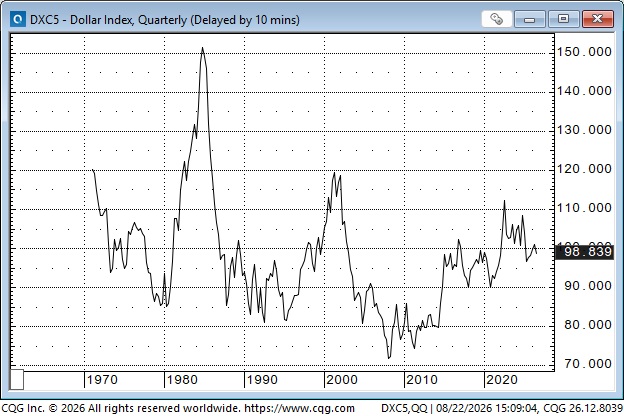
This chart of the DXY US Dollar index shows that current prices are around the midpoint of where they have been for the past 55 years (or the past 10 years, if you want a shorter look-back period).
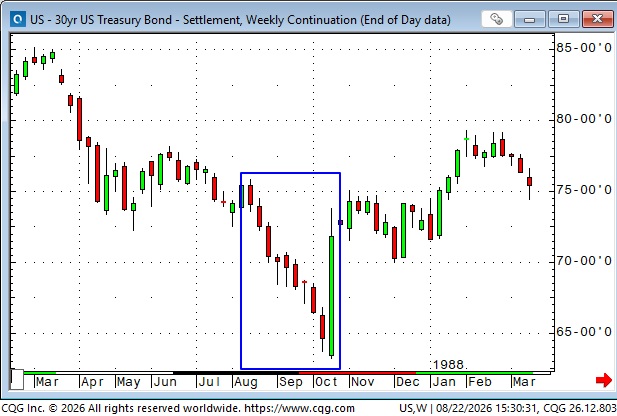
For nearly all of my 50+ years of trading experience, I’ve heard stories about how/why we were about to be hit with cataclysmic change. Believe me, I’ve lived/traded through some pretty dramatic market moves. I fondly remember making 10X owning bond calls in the week of October 19, 1987. Bond prices had tumbled ~12 full points in the preceding 9 weeks, reaching yields of ~10.5%, and short rates were ~9.5% (compare that to today’s rates), and they soared on Tuesday following the ~25% drop in the US stock indices on Monday, October 19, 1987.
I don’t think the Treasury Secretary has “panicked,” and that we are about to see yield curve control (which would put pressure on the USD just like yield curve control in Japan put pressure on the Yen. The Yen became the “pressure release valve” when the BoJ blocked bond yields from rising).
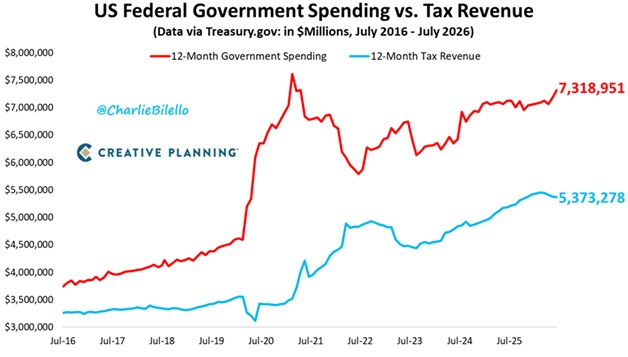
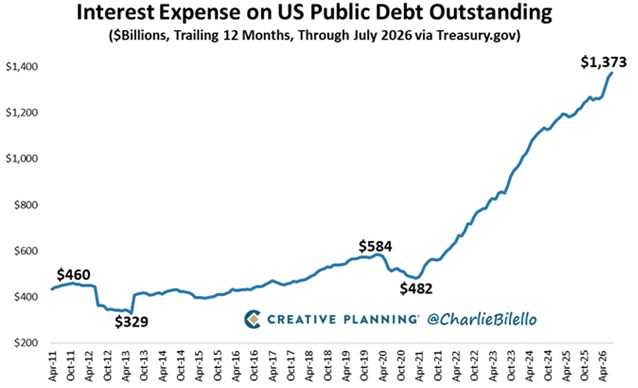
I understand the “debasement trade.” To me, if the government continually spends more than it receives in revenue (deficit spending), that reduces the currency’s purchasing power, which is the classic description of inflation. So yes, we’ve got inflation, and people understand that the prices of things they have to or want to buy are rising faster than the CPI. The Thursday 30-year TIPS auction cleared at a 2.97% real yield.
Here’s a quote from Howard Marks (I’ve read his books and followed him for years) that I think applies to the market reaction to the Treasury announcement:
“In the real world, things fluctuate between ‘pretty good’ and ‘not so hot,’ but in investing, perception often swings from ‘flawless’ to ‘hopeless.’ That says about 80% of what you need to know on the subject.”
Here’s another quote, this time from market veteran James (Jim) Grant. I’ve read half a dozen of his books and have followed him for decades: “When it comes to asset allocation during an inflationary period – buy STUFF, sell PAPER.”
Currencies
The “biggest casualty” of the Treasury announcement seems to be the USD, which fell against most actively traded currencies this week, though it remains near the middle of the range it has been in for the past 18 months.
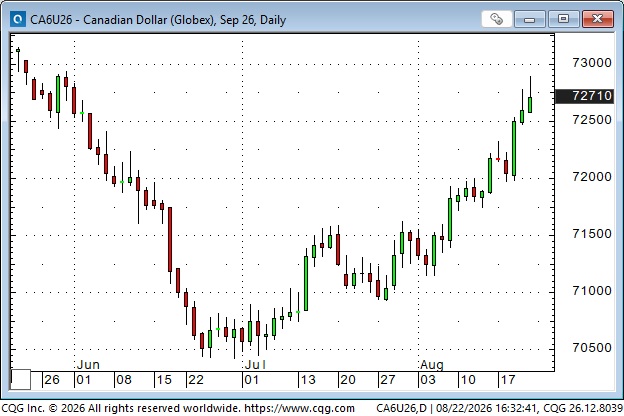
The Canadian Dollar has rallied ~3% over the past four weeks as the DXY US Dollar index has fallen ~3%. There has been some covering of the record-sized speculative short position in the futures market (as of August 18 COT data), US interest rate spread premiums have narrowed a bit, rising oil prices may have helped the CAD, and, before late Friday’s news to the contrary, it appeared that Canada and the US were settling their trade disputes.
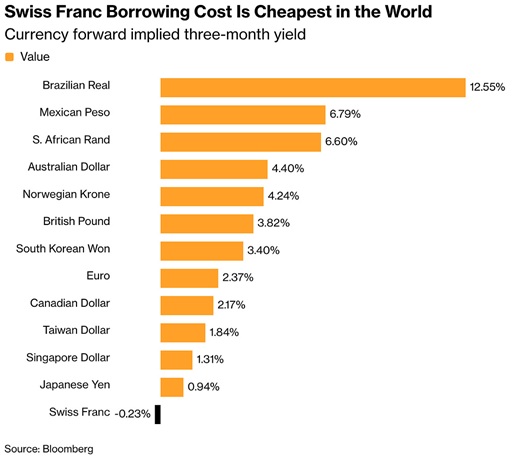
Interest rate differentials are a “big deal” in the currency world. When hedge funds borrow in a low-interest currency like the Yen and invest in a higher-yielding currency, like the Mexican peso, that is called a carry trade.
Energy
The military de-escalation in the Iran war is good news, but the continuing stalemate has pushed crude oil and product prices higher.
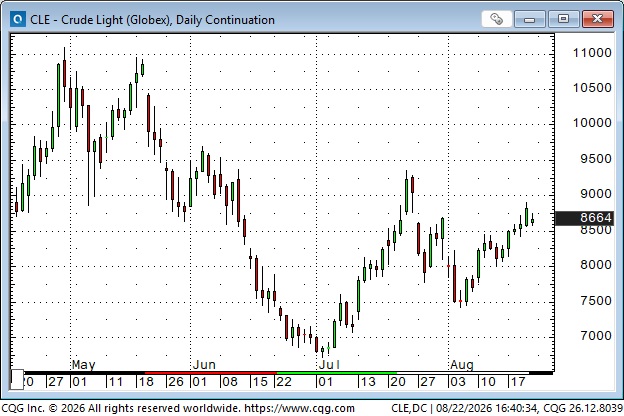
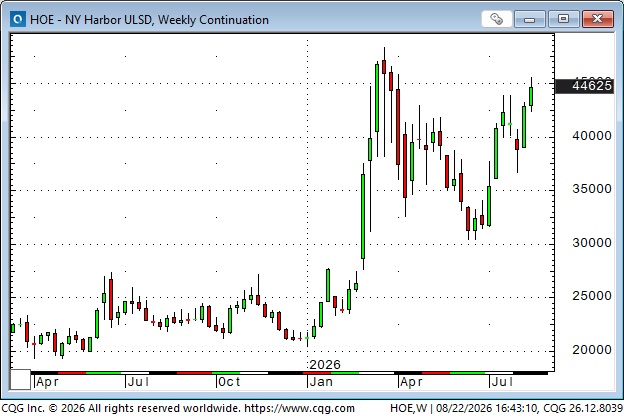
NY Harbour Ultra Low Sulphur Diesel is trading near record highs.
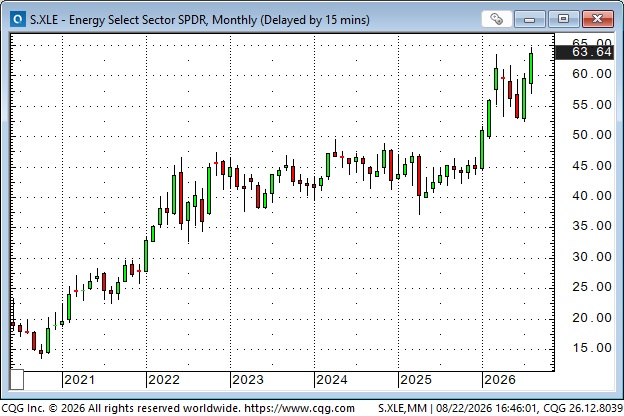
The American SPDR ETF of energy shares is trading at all-time highs.
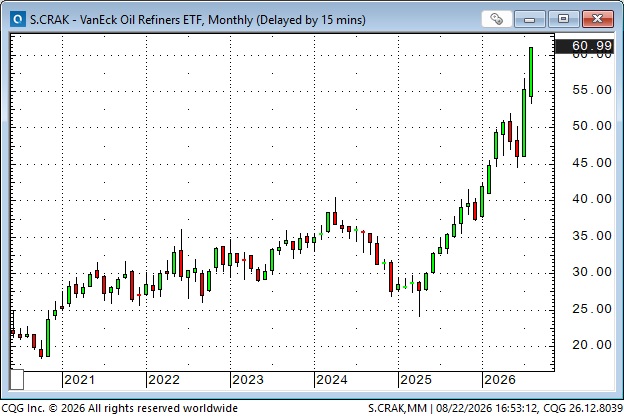
The American refinery ETF, CRAK, is soaring.
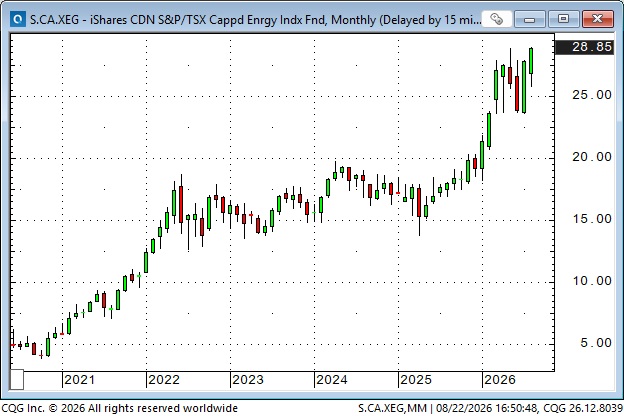
The Canadian iShares Energy Index Fnd is nearly at the 2008 all-time high.
Oil refineries
China and the USA both have refinery capacity of around 18.5 mbd. American refineries are running at over 95% capacity. China, apparently, is running substantially below capacity. Russia has effectively around 5 mbd of capacity (technically it’s closer to 6 mbd, but really it’s 5 mbd), and as much as 3 mbd is offline due to Ukrainian attacks. The Middle East has around 10 mbd of capacity, but shipping constraints limit delivery. I’ve seen estimates that as much as 10% of global refining capacity (~100mbd) is offline (or unable to deliver).
Crack spreads are at record highs, and product prices have risen relative to crude oil prices due to a shortage of deliverable refinery products.
With American refineries running flat-out (and exporting record amounts of product), global prices would likely jump if Gulf Coast refineries had to shut down during hurricane season, especially if Trump limited exports to curb the rise in domestic supplies.
Dutch Natural Gas prices:
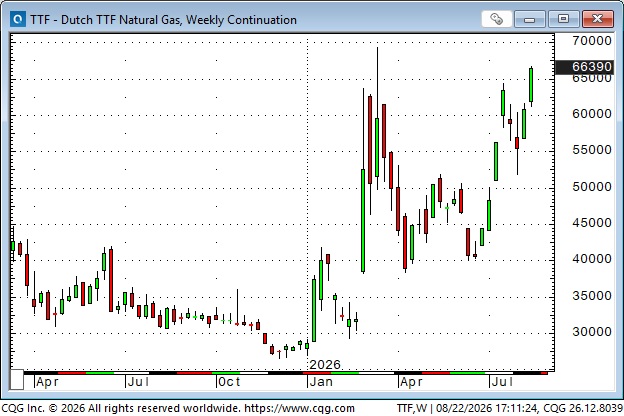
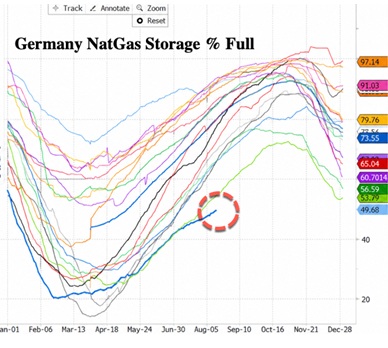
Current German natural gas storage (circled) is ~50%, well below previous years. Constraints on LNG exports from Qatar are boosting European prices, and prices may rise as countries bid for winter supplies. Russian limits on gasoline and diesel may also impact European fuel supplies.
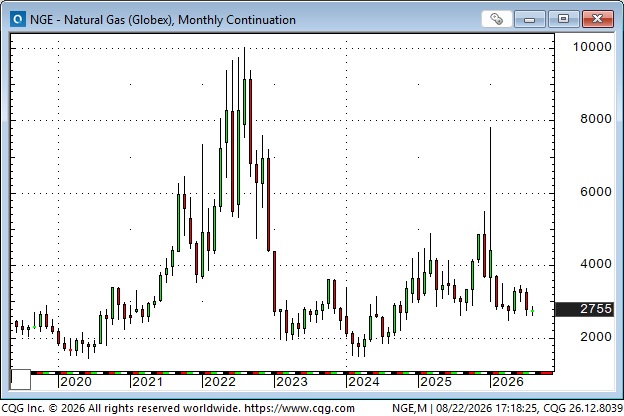
Henry Hub natural gas prices:
My short-term trading
I started this week long the CAD (bought 2 weeks ago) and short the S&P from Friday of last week.
I was stopped out for a good gain on the short S&P when the market rallied on Wednesday’s Treasury announcement. I reshorted the S&P later in the day when the rally ran out of gas and took profits Thursday night.
I covered the short CAD for a nice gain when it fell back from Monday’s highs. I missed the CAD jump on the Treasury announcement. I shorted the CAD on Thursday, thinking it had run too high, but was stopped for a small loss on Friday.
I shorted the Yen on Wednesday after it rallied on the Treasury announcement and kept the trade into the weekend.
My P+L had net gains this week, and the only open trade I held into the weekend was the short Yen.
Thoughts on Trading
Here’s another link to a great piece by Stephen Innes (a Canadian veteran trader living in Thailand) from his One For The Traders series. Its focus is on risk management. (Regular readers know that I keep saying that I make money from trading not because I’ve got a great crystal ball, but because I’m really good at managing risks.)
On my radar
Here’s a calendar for the coming week from Brent Donnelly:
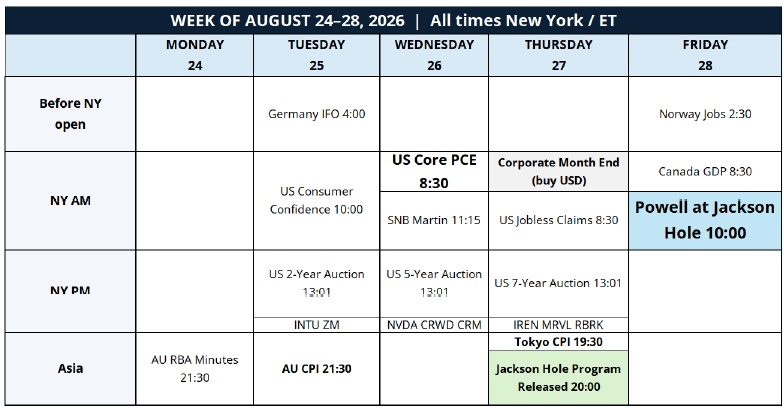
We may see the specifics of the sanctions against Iran (and any of their trading partners) on Monday. The NVDA quarterly report Wednesday afternoon could move the market. The BLS reports their benchmark jobs revisions on Friday. Recently, job numbers have been revised lower.
The Barney report
Barney loves to watch the neighbourhood from his “watchtower” in an upstairs bedroom window. If he sees anyone “unusual,” he barks a warning. On slow days, when there is nobody to bark at, he catches a nap with his chin on the armchair.

Listen to Mike Campbell and me discuss markets
On this week’s Moneytalks show, Mike and I discussed the dramatic price action across markets following the unexpected Treasury announcement. You can listen to the entire show here. My spot with Mike starts around the one-hour and 4-minute mark.
The Archive
Readers can access any of the weekly Trading Desk Notes from the past six years by clicking here.
Subscribe: You have free access to everything on this site. Subscribers receive an email alert when I post new content, typically four to six times a month.
Victor Adair retired from the Canadian brokerage business in 2020 after 44 years and is no longer licensed to provide investment advice. Nothing on this website is investment advice for anyone about anything.