
Recent headlines report that bond yields are surging higher
The benchmark 10-year Treasury futures contract closed lower for the last six consecutive months, with the yield (in the cash market) rising from ~3.95% at the end of February (before the war in Iran began) to ~4.79% on Friday. (Blue box on the chart).
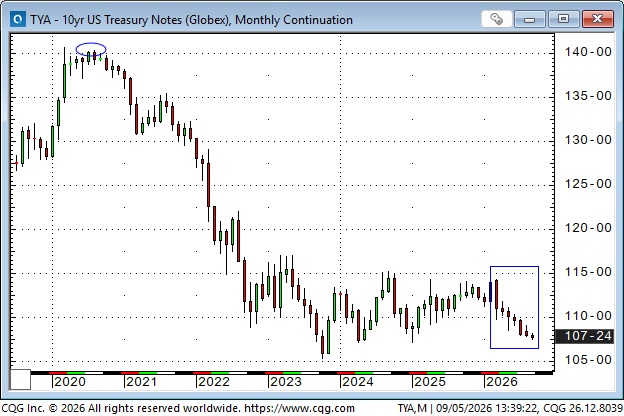
The ellipse on the chart above surrounds August 2020, during the “pandemic,” when the 10-year yield touched ~0.50%, a historic low.
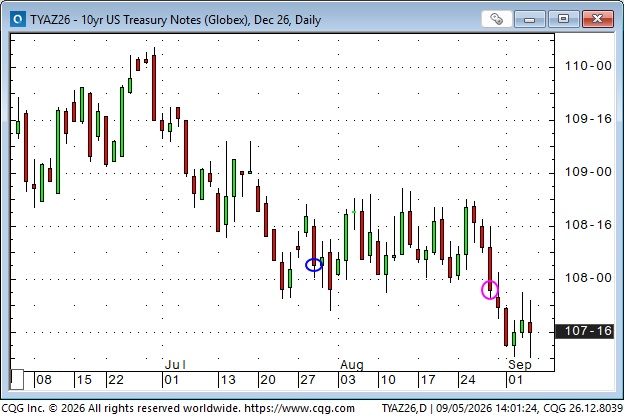
On a much shorter time frame, the 10-year futures closed lower on July 29 (blue ellipse) when Warsh (following his first FOMC meeting as Chairman) sounded dovish about short-term rates. Ironically, the 10-year closed lower again on August 28 (pink ellipse) when he sounded more hawkish at Jackson Hole. The lower close on August 28 and the subsequent lower prices this week may explain the recent headlines about surging bond yields.
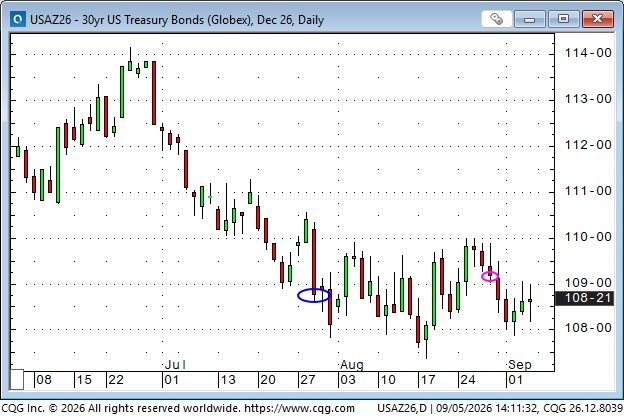
On the 30-year futures contract, the price closed higher on August 28 than on July 29. In fact, 30-year prices have chopped sideways for the last 6 weeks. Yields are NOT surging higher, although they may be “at risk” of surging higher as markets “get real” following the Labour Day weekend.
I believe that Treasury Secretary Bessent and Fed Chairman Warsh are keenly aware that bond yields could be “at risk” of surging higher, and they will try to keep that from happening. The obvious risks include spikes in energy prices, geopolitical events, and/or “policy errors” with unintended consequences. The Treasury issuing more short-term debt and less long-term debt, in combination with the Fed raising short-term rates, may help keep long yields from rising.
PPI and CPI reports are due this coming Thursday and Friday, respectively, and the FOMC meets on September 15 and 16. If the PPI and (especially) the CPI reports are “hot” and the Fed fails to announce an increase in the funds rate on the 16th, that would be an enormous “policy error,” and I’d expect bond yields to surge higher and the USD to fall.
In previous Notes, I’ve mentioned a history of Fed Chairs being “tested” by the market shortly after assuming their role (Volker, Greenspan, Bernanke, and Powell come to mind). Warsh may also soon be “tested” if the CPI data is hot and Trump continues to rant about the need to CUT interest rates.
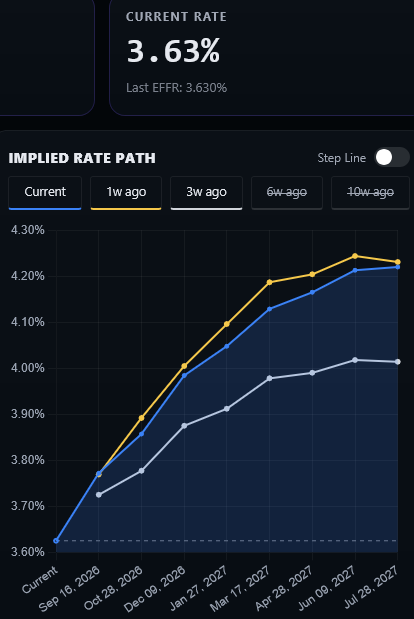
This chart from rateprobability.com shows the current effective funds rate at 3.63%, with the market now pricing a rate of 3.77% following the September 16 FOMC meeting, implying a 59% chance of a 25 bps raise. If the PPI and the CPI come in hot, I’d expect markets to price in closer to a 100% chance of an increase in the funds rate. (If CPI were “sizzling,” markets would likely price in over 100%, implying the possibility of a 50 bps hike).
Markets are pricing in an ECB rate hike this Thursday from 2.25% to 2.5%, and to 2.75% by December.
Japanese bond yields have risen sharply since the BoJ began tapering its JGB (yield control) purchases in July 2024. Markets are currently pricing a BoJ rate hike from 1.00% to 1.25% next week, with rates rising ~100 bps over the next 12 months.
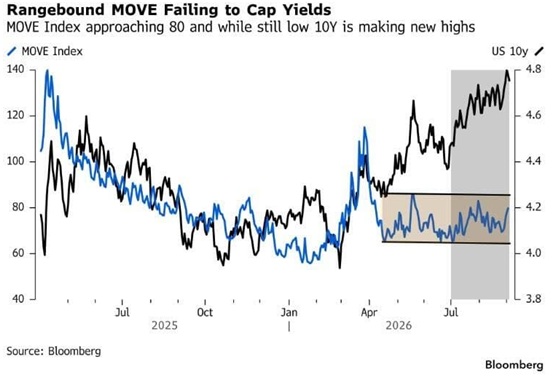
The MOVE Index (a bond option volatility index – blue line) has drifted sideways after spiking during the first 10 weeks of the war in Iran, even as US 10-year bond yields have been rising (black line). The sideways drift in the MOVE implies that the bond market has not been “stressed” by rising yields.
Quote of the week – Michael Hartnett, Managing Director and Chief Investment Strategist at BoA
“Bonds trade information. Equities trade ideas.”
Stephen Innes explains Michael’s cryptic quote:
“Stocks can spend months falling in love with a narrative. Bonds are usually less romantic. They must finance the story, absorb the issuance and decide what future cash flows are worth after inflation, deficits and interest costs have taken their share.
That distinction matters because the artificial intelligence boom is no longer being funded by earnings enthusiasm alone. It is increasingly passing through the bond market, where hyperscalers, data centre developers and infrastructure companies are raising enormous amounts of capital to finance compute, power and construction. The stock market is still trading the idea of AI. The bond market is beginning to price the cost.”
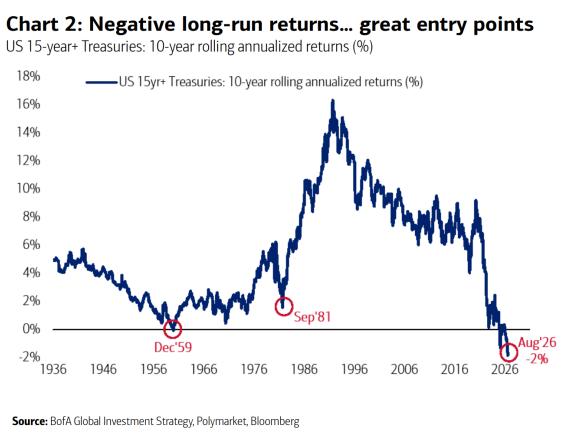
Here’s Michael Hartnett’s long-term opinion of the bond market:
Currencies
The Japanese Yen spiked from record lows against the US Dollar (and other currencies) at the end of July after intervention by Japanese authorities, with a little help from their friends at the US Treasury. Previous interventions since 2024 had failed to sustain higher prices, and this seemed to be happening again as prices drifted lower in August, giving back ~62% of the intervention gains. But the Yen surged higher again this week, apparently without intervention from Japanese or American authorities.
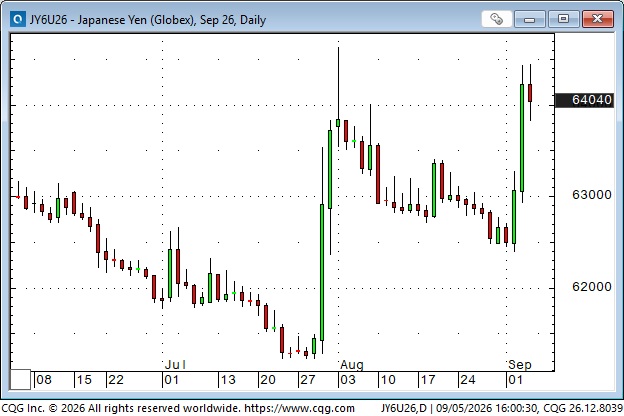
Some analysts, including Robin Brooks, believe there was “stealth intervention” by an “entity” close to the Japanese government, such as the GIPF (Government Investment Pension Fund). Other analysts believe a “major player” in the Yen carry trade may have unwound a massive short Yen position, and that the buying triggered other traders to buy Yen. We may never know who was involved, but there was a huge bid in the market for several hours, and trading volumes were very high.
In my August 1 TD Notes, I wrote that “the lows have been made” in the Yen.
“I have written about a possible turn higher in the Yen several times over the past year. The Yen is down over 50% from its 2011/12 record highs against the USD, but I believe once it finally turns, it will begin a multi-year rally (rising against other currencies more than it rallies against the USD). Intervention over the last few years has temporarily boosted the Yen, but has not created a “durable” low because fundamental policies in Japan need to change. The government runs a huge fiscal deficit, and the BoJ keeps bond yields artificially low. A weakening Yen has been a “pressure valve” in this environment. If the new Takaichi government can demonstrate that Japan is on a “new path” and if repatriation flows begin, then the Yen may start a self-sustaining rally. I think there’s a good chance that “the lows have been made” this week (markets are forward-looking), but “real money” accounts will be cautious and slow to move.“
In previous Notes, I frequently commented that Asian mercantilist policies (countries kept their currencies artificially low to foster trade surpluses and to remain competitive with one another) made it difficult for any Asian country to independently revalue their currency higher because it would lose “market share” to other Asian countries that maintained an undervalued currency.
That may be changing. Over the last 18 months, the Chinese RMB has risen ~8% from record-low levels against the USD. Given that the exchange rate is “managed” by the Chinese authorities, I assume this rally was “intended” by the government (perhaps they are embarrassed by their massive trade surpluses!). In this chart, lower prices mean that it takes fewer RMB to buy one USD.
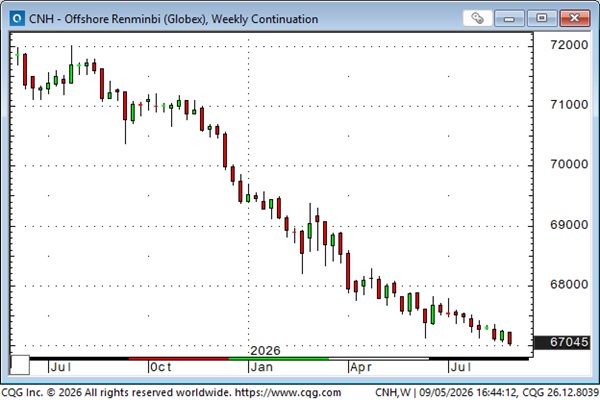
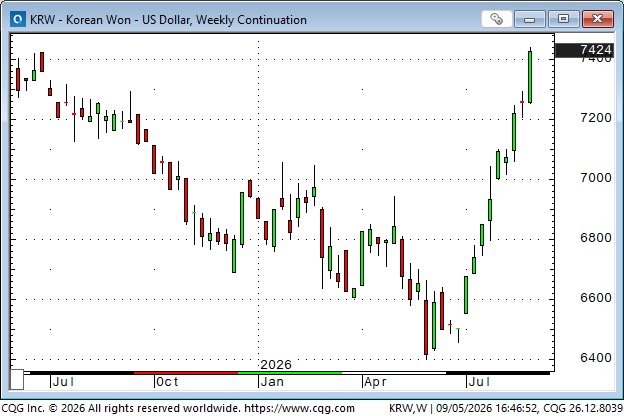
Whatever the “reason” for the RMB rally, I think it “opens the door” for other Asian exporters to allow their currencies to rally, without fear of giving up “market share” to other Asian countries. The Korean Won has rallied ~15% in the last three months from near-record lows (I understand that may have something to do with the spectacular volatility in the Korean stock market), but still, if the RMB and the Won are rallying, that may make it easier for the Yen to rally. The Taiwan Dollar has rallied ~3% against the USD in the last month. And finally, if it matters, Trump wants Asian currencies to be higher to weaken their mercantilist trade policies, to lower the US trade deficit, and to “bring manufacturing back to the USA.”
Energy
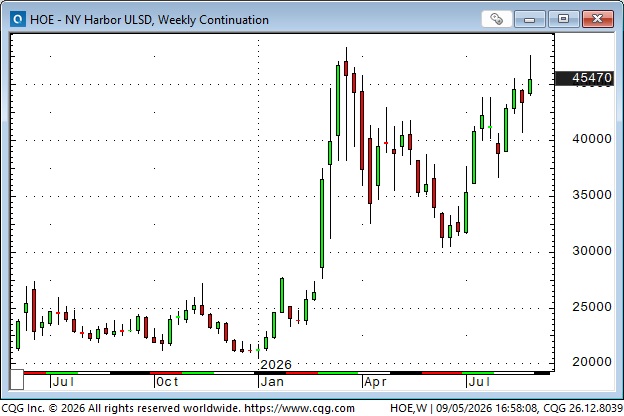
The US national average diesel price is at a record-high $5.85 per gallon. The US is exporting record amounts of refined product, and refineries are running flat out. Heating oil and diesel stocks are low relative to previous years. Harvest season, winter heating oil demand, and refinery shutdowns for seasonal maintenance may put additional upside pressure on product prices. Will Trump limit energy exports ahead of the midterms?
European natural gas prices continue to rally as the continent’s storage levels are at multi-year lows and winter is coming. (I could be short the Euro on their energy policies alone!)
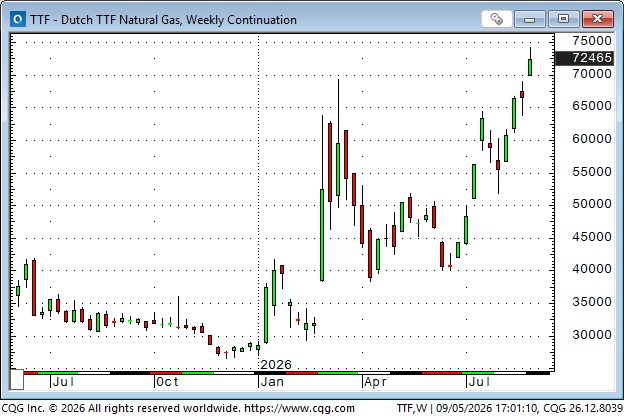
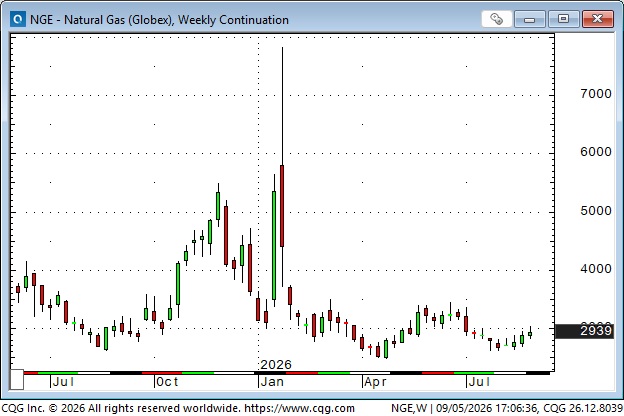
Meanwhile, as natural gas prices soar in Europe and Asia, front-month US natural gas prices have been trending lower (a combination of physical restraints on getting US and Canadian gas to Europe and Asia and a superabundance of natgas production in North America).
On my radar
September 10: PPI, ECB; September 11: CPI; September 16: FOMC; September 17 evening: BoJ; September 24: XI at the White House; October 19: Alberta votes.
My short-term trading
I started this week short the Yen, the Euro, and the S&P, and long bond call options.
I covered the Yen on Monday for a decent gain (I would have been stopped for modest profits if I had held the position when the Yen rallied hard on Wednesday).
On Tuesday, I covered the Euro for a decent gain, and the bond calls for a modest loss.
I covered the short S&P on Wednesday for another decent profit and stayed flat ahead of Friday’s employment report and into the weekend.
Monday morning edit: I was not flat into the weekend. I forgot I had shorted the S&P during Friday’s day session, when the market traded below the lows made immediately after the NFP report. I remained short into the weekend.
Thoughts on Trading
My friend Stephen Innes is a Canadian veteran trader living in Thailand. I subscribe to his Substack and highly recommend him to active traders. He wrote a terrific piece called “Better To Be Lucky Than Good” that goes to the heart of the trading life. Here’s a brief quote: A trader can make money for six months doing something catastrophically stupid and convince himself he has discovered a new law of finance. Another trader can make a series of excellent probabilistic decisions, get run over by variance and begin questioning whether he knows anything at all.
The Barney Report
My son came to the Island last week. We played some golf, and after dinner we went out on the golf course with Barney so I could show Drew how good Barney is at finding golf balls. He finds balls I can’t see with his nose. I give him a dog treat when he gives me the ball. I say he’s working for food! It’s not unusual for him to find a few dozen balls during an evening ball-hunting session. I wash them up and give them away from a bucket on the rock wall that separates our patio from the golf course.

Listen to Mike Campbell and me discuss markets
On this week’s Moneytalks Show, Mike and I discussed the upcoming FOMC meeting, the bond market, the energy markets and the upcoming midterm elections. You can listen to the entire show here. My spot with Mike starts at the 1-hour and 8-minute mark.
Listen to Jim Goddard and me discuss markets
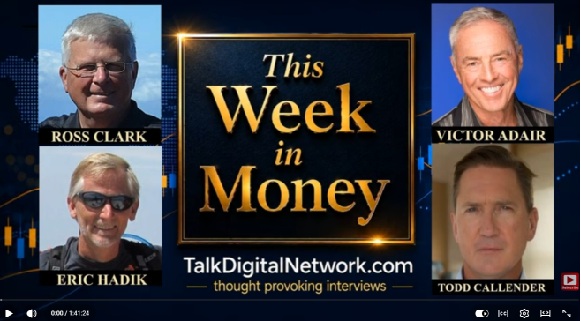
I recorded my monthly 30-minute interview with Jim on the This Week In Money show on Friday. We discussed markets getting “back to reality” after the Labour Day weekend, the bond market, the stock market, gold, energy markets, the Yen and the midterms. You can listen to the entire show here. My spot with Jim starts at the 10.30 minute mark.
The Archive
Readers can access any of the weekly Trading Desk Notes from the past six years by clicking here.
Subscribe: You have free access to everything on this site. Subscribers receive an email alert when I post new content, typically four to six times a month.
Victor Adair retired from the Canadian brokerage business in 2020 after 44 years and is no longer licensed to provide investment advice. Nothing on this website is investment advice for anyone about anything.